Sun, 12 Mar 2006
Shorting Residential Real Estate
Patrick wants to short the housing market. This is something I've thought about over the past year or so.
I could short builders, mortgage banks, or Fannie Mae, but that's not exactly the same, and I'm not as confident they will fall.
I'm not sure why he doesn't want to take a short position in equities that are likely to track housing prices. If prices start to fall it'll likely be because people are defaulting on their mortgages. This will negatively impact those holding mortages, i.e. banks, Fannie Mae and Freddie Mac. As Greenspan pointed out, the GSEs are holding onto lots of mortgages.
I read How to Profit from the Coming Real Estate Bust yesterday, and the author, John Rubino, suggests a number of ways to make money when the euphoria ends. He, of course, suggests shorting the GSEs, banks, and builders. But the housing market doesn't exist in a bubble (pun intended). The fall in housing prices is likely to correspond to a fall in the dollar. It is foreign investment in dollar debt that is helping to keep interest rates low. When foreigners get tired of financing American consumers, and not making much money doing so, they'll take their money elsewhere causing the dollar to fall. (Yes, I realize it's not that simple. Foreign governments also want to keep their exports affordable.) To get them back, we have to offer higher returns, i.e. higher interest rates, on their investments. Higher interest rates make for grumpy homeowners with ARMs, over half of recent home buyers. For a thorough discussion of the problems ahead for the dollar, check out The Dollar Crisis: Causes, Consequences, Cures. Rubino thinks Swiss Francs are the way to go. I'm not sure of that. I have money in Yen and Canadian Dollars right now. Subscribe to Chuck Butler's Daily Pfennig for daily commentary on foreign currencies.
Gold and other precious metals are another way to make money from a falling dollar.
Some more directly housing related stocks to short are those of title insurers, appliance and furniture manufacturers, property development companies and REITs. He also suggests going long apartment REITs and health care REITs. Apartments should do well, but I'd be more wary of the latter. REITs that own nursing homes should do OK, but I'd be hesitant to invest in hospitals which seem to be closing with increasing frequency as doctors are required to provide services to people who don't pay their bills.
Keynes Was a Socialist
Brad Delong (via Calculated Risk) has posted part of Paul Krugman's introduction to Keynes's General Theory of Employment, Interest and Money. Having not ready General Theory yet, I'll have to comment on Krugman's interpretation of it.
Stripped down, the conclusions of The General Theory might be expressed as four bullet points:
- Economies can and often do suffer from an overall lack of demand, which leads to involuntary unemployment
- The economy's automatic tendency to correct shortfalls in demand, if it exists at all, operates slowly and painfully
- Government policies to increase demand, by contrast, can reduce unemployment quickly
- Sometimes increasing the money supply won't be enough to persuade the private sector to spend more, and government spending must step into the breach
Sorry if my comments are naive; I am but a budding student of economics.
1. How can an economy suffer from an overall lack of demand? The overall
demand in an economy is made of up of individuals' demand. Who is Keynes
to say that my demand is too high or low? The most I could demand today is
limited by my productivity since birth plus any wealth gifted to me. If I
decide for forgo consumation today for tomorrow, no one has the right to demand
that I trade with them today.
2. If there isn't enough demand for what I can supply, I must find something else
to supply. For example, if I decide that the demand for my services as a
computer consultant are not sufficient to generate the income I desire, I might
go back to school to study economics. (Yes, I know I'm probably deluding
myself to think that my services as an economist will be more valuable to
society, but at least it's fun.)
3. How can government increase demand and reduce unemployment quickly? Let's see.
They can print out some money. Of course, they have to do this sneakily. If
they were to announce, "Tommorrow, we are going to increase the money supply by
1%," everyone would increase their prices right away (except for those lenders
and employees with dollar-denominated contracts; they're screwed). Instead,
people must be caught by surprise that they now have come into more money,
thinking that it must be due to their prowess and innate brilliance, so they go
out and spend their new dollars of spinning hubcaps and macaws.
4. Or, rather than just injecting money into the economy, the government itself
can go shopping. Of course, since the government doesn't actually produce
anything, it can only spend the wealth that it confiscates from its citizens.
Now, they might not take that money from you today, but they'll get you for it
later. And to make matters worse, when the government goes out to Walmart to
spend some money, they're competing with you, and thus forcing prices up.
Thu, 09 Mar 2006
Cheating with Turnitin.com
Turnitin.com is a service schools can use to detect plagiarism. Students submit their papers to turnitin.com, in MS Word format, I guess, and it analyses the text for plagiarism. Here's how the company describes it:
The industry's most advanced search technology that checks papers against our in-house copies of both current and archived internet content and our proprietary database of millions of previously submitted student papers.
My Economics professor told us an amusing story this morning about turnitin.com. She is on a committee that was evaluating using the service. Going through a demo of the service while on the phone with a rep from the company, she asked what happens if the student hides nonsensical characters within the text by replacing whitespace with characters in a white font. She went ahead and tried it with the sample plagiarized poem the company provided. Lo and behold, the poem was reported as not being plagiarized. Despite one professor's continued desire to use this $5,000 service, the committee opted not to.
Sun, 19 Feb 2006
iPod Shuffle Still Won't Shuffle
I thought that perhaps the reason why my iPod Shuffle wouldn't shuffle was that I had created the directory structure and loaded the files using gtkpod rather than iTunes. To test this theory, I wiped everything from the iPod's filesystem, started up VMware with Windows XP, installed iTunes, and loaded about three albums of music onto my iTunes-initialized iPod. I disconnected the Shuffle, switched to shuffle mode, and pressed play. Nothing. Back in linear mode, it works fine.
As a new consumer of Apple products, I'm not terribly impressed. The end cap on my shuffle doesn't quite fit correctly. When it's on, I can feel the raised edge where the cap meets the Shuffle. It's not a big deal, but it doesn't live up to the expectation that Apple products are engineered to perfection. It definitely falls short of the excellence achieved by the Tivo Remote, for example.
I'll probably stop into an Apple store to see if they'll replace my defective Shuffle. I'm not expecting much, though. My friend, Randy, is on his second defective iPod. His current one is having a battery problem and (from what I overheard in the cubicle farm), even though it is still under warranty, Apple wants him to pay $30 to ship it to them.
Postman/C-client Certificate Problem
When I upgraded my mail server from Woody to Sarge, Postman, my webmail client, stopped working. When trying to log in, I got the following error:
Error: Certificate failure for mail.xerus.org: self signed certificate: /C=US/ST=California/L=Los Angeles/O=Xerus/CN=mail.xerus.org
It turns out that the newer version of C-client, the library that postman uses for IMAP, automatically tries to verify the certificate, even if you have postman configured to connect to the non-SSL port; I guess it calls STARTTLS. Since I'm only using a self-signed certificate, I get the error above.
The solution is to configure postman to not verify the certificate using the
novalidate-cert switch in /etc/postman/interdaemon.cfg.
[mail.xerus.org]
imapserver     = mail.xerus.org/novalidate-cert
imapport       = 143
smtpserver     = localhost
;for SMTP authentication. 0=No,1=Must,2=Try
authsmtp       = 0
maildomain     = xerus.org
mailboxprefix  =
remotepath     = ~/mail/
deniedservices =
tech » mail | Permanent Link
The "Problem" of Evil
During my first Critical Thinking class, the the professor assigned a paper on the problem of evil. Here's how Wikipedia describes the problem of evil:
The problem of evil assumes that God is both benevolent and omnipotent. One formulation of the problem of evil may be schematized as follows:
- If God exists, then there would be no evil in the world.
- There is evil in the world.
- Therefore, God does not exist.
Our assignment was to come up with an argument against the problem of evil. It was definitely a good way to dive into the course. I spent a lot of time thinking about the problem and reading up on arguments that others had come up with.
I think I did a decent job considering the minimal amount of instruction we received prior to the assignment and my rusty essay-writing skills.
Christian G. Warden
Word Count:
1058 In Evil and Omnipotence, J. L. Mackie summarizes the problem of evil to show that the theist's belief in the existence of God is irrational. Not only is reason unable to prove the existence of God, but the beliefs of the theist are in direct conflict with each other.
The problem of evil argues that, because of the nature of God and the existence of evil, God cannot exist. The main beliefs regarding God with respect to the problem of evil are that God is omnipotent and omni-benevolent. Though not explicitly stated by Mackie, it is generally accepted that God's omnipotence subsumes his omniscience; that is, there are no situations over which God could not have control due to his ignorance thereof. The conflict arises because, in spite of God's all-powerful and all-good nature, evil exists.
If God were omnipotent and omni-benevolent, he would prevent evil from occurring. Therefore, accepting the premise that evil does exist, either God does not exist, or God is either not as good or not as powerful as is commonly held.
Mackie points out that the problem of evil is only a problem for people who believe that God exists, and that God is omnipotent and omni-benevolent. No such problem exists in the minds of brights (those with a naturalistic view of the world), polytheists who believe in gods with conflicting goals, nor monotheists who believe in a god which has limits to its power, knowledge, or goodness. For example, consider the following argument regarding a different supernatural being, the Flying Spaghetti Monster1:
If the Flying Spaghetti Monster (FSM) exists, everyone would be a pirate.
Everyone is not a pirate.
The FSM does not exist.
Few objections would be raised to the conclusion above because, to paraphrase Richard Dawkins2, we are all Flying Spaghetti Monster atheists; there is no "problem of pirates" commonly discussed among philosophers.
So, in attempting to rebut Mackie's argument, we must presume that God exists or, at least, that we have strong reason to believe that God exists.
We can concede that the premises of the problem of evil conflict without accepting that the conclusion is valid. If we accept that the God is great (omnipotent and omni-benevolent), it follows that God would not, and indeed could not, have created a world with evil. Furthermore, if the world God created were about to be subjected to evil, he would be able to and would be compelled to prevent it. That would mean that the second premise, that evil exists, must be false. The existence of evil seems self-evident, though. So how can we claim that evil does not exist?
We can think of evil as being relative to good. Every act by a human could conceivably be better (more good) or worse (more evil). Likewise, any natural act that affects mankind could be better for mankind or worse. There is no concrete distinction between an evil act and a good one. There can only be judgments made between the relative goodness of two acts or events.
When we say that God is all-good, that means infinitely good. If there is an infinite scale of goodness in our world and all possible worlds, there is always the possibility of more goodness, for infinite means that there are no bounds. So, the problem of evil could be similarly stated as the problem of imperfection:
If God exists, the world would be perfectly good.
The world is not perfectly good.
God does not exist.
Stated this way, it seems more logical to accept that God is omni-benevolent despite the fact that we can find evidence in the world of imperfection.
If we consider good and evil not as a duality, but rather a scale of goodness, it becomes clear that the case for saying that evil exists is not quite as strong. Instead, it might be better stated that the best scenario does not always occur. But this is a necessary condition of a world in which goodness is infinite. For any event perpetrated or allowed to occur by God could always be upstaged by an even better one.
It is also possible that humans, not being omniscient, are unable to appreciate an apparently evil act in its full context. Because there are an unlimited number of events occurring in the world, and an unlimited number of interactions among natural events and living beings, both sentient and not, it is impossible to judge the totality of a single event's goodness. Often, different value judgments will be made upon an act viewed from different perspectives.
Consider the execution of a convicted murderer. The family of the murderer's victim might view the execution as the ultimate good act, while the murderer's family might view it as the most evil. Taking into account the values of the rest of society or humanity, the execution would be valued as somewhere in between the two extremes. The value of the act would be different still in the context of subsequent events that it influences.
While it seems all too easy to find evil in the world, upon further contemplation, such evil can easily be redefined in terms of its relative position on a scale of goodness. And although an argument against the problem of evil does not prove the existence of God, it demonstrates a method of reconciling a belief in God with the apparent evil that surrounds us.
Murray, Michael, "Leibniz on the Problem of Evil", The Stanford Encyclopedia of Philosophy (Spring 2005 Edition), Edward N. Zalta (ed.), <http://plato.stanford.edu/archives/spr2005/entries/leibniz-evil/>.
Wikipedia Contributors, "Problem of evil", Wikipedia: The Free Encyclopedia, 7 February 2006, <http://en.wikipedia.org/w/index.php?title=Problem_of_evil&oldid=38547800>.
Wikipedia Contributors, "Theodicy", Wikipedia: The Free Encyclopedia, 4 February 2006, <http://en.wikipedia.org/w/index.php?title=Theodicy&oldid=38081634>.
1 The Flying Spaghetti Monster is fictional god-like being invented in 2005 CE to parody the "Intelligent Design" advocates wishing to teach creationism in US schools. One of the defining characteristics of the FSM is its fondness for pirates. See www.venganza.org for more information.
2 Richard Dawkins states in "The Root of All Evil?", a television special for Channel 4 in the UK, that we are all teapot atheists with respect to Bertrand Russell's teapot in space.
My argument is admittedly weak. Our second assignment is going to be to rewrite this essay, so hopefully the class will have improved my arguing skills before then.
Update: I've completed my second paper on the problem of evil. I had the option of changing my argument to be in agreement with the problem of evil, but I got lazy, and kept my original argument.
Sat, 18 Feb 2006
Back to School
I started back at school last week. After dropping out of the computer science program at LMU almost 9 years ago, I'm going to give school another shot.
I'm going to Pierce College, a local community college. I hope to transfer to UCLA or one of the other UC campuses next year to study economics.
Mon, 16 Jan 2006
Schwarzenegger Causes Traffic
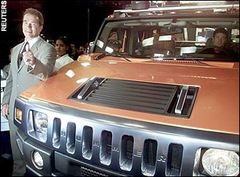 I got stuck in traffic on Friday because Schwarzenegger was standing on a pile
of rocks next to the 405 in front of a bunch of TV cameras. He was causing
traffic while announcing funding
for a carpool lane.
Thu, 05 Jan 2006
Good Coffee


So, I finally got a proper coffee machine, a DeLonghi espresso maker. I bought some pre-ground espresso from Caffe Latte on Wilshire since I only have a whirling blade grinder, which I've read is not recommended for espresso. I'll try out the grinder later, but I wanted to make sure that my first cup of coffee was delicious, and it was. The machine also came with some Illy pods, but I haven't tried them out yet.
Now that lattes don't cost $3, I want to drink them all day, and I'm worried about excessive caffeine intake. The problems of living in modern society...
Abuse of Popular Credulity


I don't know how courts work in Italy, but in the US, witnesses are asked to
swear on the Bible. Doesn't doing so assume that the text within is factual?
I don't think they let you bring in your own books