Thu, 24 Sep 2015
restartd, a Process Monitor-and-Restart Daemon
Restartd is a daemon for checking your running and not
running processes. It reads the /proc directory in every n
secs and does a POSIX regexp on the process names. You can
execute a script/program if the process is not or it is running.
In general, I don't like automated systems that restart processes. If a process dies unexpectedly, there is a problem that needs to be addressed by a human. Automatically restarting processes that randomly die makes it too easy to ignore the underlying problem.
In the case of clamd, the ClamAV daemon, I have acquiesced because I
cannot figure out why it dies randomly every month or two, and have installed
restartd.
The best thing about restartd is it's simplicity. It reads /proc/*/cmdline
every n seconds and compares each command with the list of processes defined in
it's config file. I have it configured to monitor clamd, spamd, and our
in-house Exim log-to-database utility, exidblog, and to call the
appropriate init script to restart a process if it's not running.
The current version of restartd in Debian Sarge (and Sid),
0.1.a-3, is a bit buggy in that it will fail to restart services if it is
started from an interactive session once the session is closed. Based on
suggestions
and code by Glen Turner, I've patched restartd to redirect
stdin/stdout/stderr to /dev/null, change the working directory to /, and
disassociate from the controlling terminal.
I've made the patched Debian package available for download.
Tue, 11 Nov 2014
Net Neutrality
Thinking past hop 1
I had a great idea a few days ago, to start a website streaming cat videos called Petflix. I rented a server for $10/month that gave me 1Mbps of outbound bandwidth.
Growth has been exponential. I now have 20 customers that now pay me $1/month for streaming cat videos. Unfortunately, during peak cat video viewing hours, I've started getting complaints that the video streams are choppy.
Each stream uses 100kbps. So when I get more than 10 concurrent viewers, I max out my bandwidth, and packets start getting dropped.
I could buy another 1Mbps of bandwidth for $10/month, but that would make my website unprofitable. So I came up with a brilliant idea that would keep this operation going.
I have an old computer in my basement that I'm not using. I called up Comcast and offered to send them my computer, preloaded with all of my cat videos. They could install it in their data center, and I would configure my DNS servers to send all of my traffic originating from Comcast customers to the computer in their data center. Since 90% of my customers are on the Comcast network, I can grow my website without incurring any additional bandwidth costs.
Obama on net neutrality
The recent statement by Barack Obama on net neutrality suffers from the same error that most proponents make in arguing for net neutrality. It assumes away the problem of how the internet actually works.
Packets don't magically appear on an ISPs network, ready for the ISP to either send on to a customer, or throttle or block for some nefarious reason.
The Internet is a big interconnected network with lots of different agreements for connecting two networks together. As the owner of Petflix, I pay Tektonic for connecting my virtual server (which I also pay them for) with their network. Tektonic pays to connect their network with TierPoint (and for power and space in a data center). TierPoint pays to connect their network with Level 3. Level 3 and Comcast connect their networks, but the terms are contentious. And as a customer of an ISP, I pay for connecting my home network with Comcast.
Traditionally, large networks like Comcast and Level 3 would form settlement-free peering agreements. Both parties get about equal value out of connecting their networks, and it was deemed mutually beneficial to connect their networks without one party paying the other. Netflix started sending lots of traffic over the connection between Level 3 and Comcast, and Comcast no longer thinks they are getting equal value from peering, and wants to renegotiate so Level 3 pays them.
To be fair, Obama sort of recognizes that the problem isn't just between the ISP and their customers. One of his bullet points argues that net neutrality should apply between an ISP and other networks.
- Increased transparency. The connection between consumers and ISPs - the so-called "last mile" - is not the only place some sites might get special treatment. So, I am also asking the FCC to make full use of the transparency authorities the court recently upheld, and if necessary to apply net neutrality rules to points of interconnection between the ISP and the rest of the Internet.
But if we apply the other rules of No Blocking, No Throttling, and No Paid Prioritization to the connections between ISPs and other networks, it's unclear what kind of arrangements would be legal. Would the government have to mandate the amount of bandwidth at these interconnects?
What We Talk About When We Talk About Bandwidth
Getting back to my parable, when a customer of Comcast pays for 20Mbps of bandwidth, and they can't even get 100kbps of throughput to Petflix, whose fault is it?
Is it Comcast's responsibility to ensure that there is enough bandwidth through Level 3, TierPoint, Tektonic, and Petflix?
Is it Petflix's responsibility?
Fortunately, we have a pretty good way of sorting it out: markets. If Petflix is so important to Comcast customers that Comcast will lose customers to competitors by not providing a satisfying cat video viewing experience, Comcast will likely work to ensure sufficient bandwidth is available, unless the cost to do so makes those customers unprofitable.
If Petflix customers start cancelling their subscriptions because they can't enjoy my videos, I will probably pay to ensure sufficient bandwidth is available, unless doing so makes the operation no longer profitable.
Net Competition
I'm sure readers will object that Comcast is nearly a monopoly in most markets, and therefore markets won't solve the problem. And I agree. So instead of championing net neutrality, I encourage readers to champion net competition.
Instead of adding federal regulation on top of local regulation which grants
ISPs like Comcast monopolies, deregulate the market in ISPs. In Portland,
there could be three
high-speed ISPs competing for consumers' business soon.
Nobody knows what amount of bandwidth should exist between the millions of
connections between networks, and who should pay how much to whom for these
connections. Only the market can sort it out.
Obamacare for the Internet?
Senator Ted Cruz referred to net neutrality as Obamacare for the internet. Is that a valid analogy?
"Net Neutrality" is Obamacare for the Internet; the Internet should not operate at the speed of government.
— Senator Ted Cruz (@SenTedCruz) November 10, 2014I would consider these the primary characteristics of Obamacare:
- Additional regulation of heavily regulated industry
- New tax on uninsured taxpayers
- Subsidies for low income residents
- New government-run market for insurance
Obamacare doesn't seem like a great analogy for net neutrality. Both do add federal regulation on top of local/state regulation. And it's not inconceivable that if the FCC were to start regulating ISPs in the way that Obama suggests, that problems caused would lead to suggestions for more government "solutions" like government-run markets for network connectivity, but that's a bit of a stretch.
With a little research, Cruz probably could have come up with an act of Congress that would make a better analogy than the ACA.
Tue, 30 Sep 2014
Changing the default browser in Debian
Note to self: the next time you want to change your default browser, here's how.
$ xdg-mime default chromium.desktop x-scheme-handler/http
$ xdg-mime default chromium.desktop x-scheme-handler/https
$ xdg-mime default chromium.desktop text/html
$ sudo update-alternatives --set x-www-browser /usr/bin/chromium
Wed, 17 Sep 2014
Fore Close

I thought it'd be a nice gesture to make up some signs for Casey. Actually, I just get a kick out of these. I'm probably the only one.
See the Housing Bubble Blog for some real news.
On Instacart Pricing Transparency
Stephen Klein, a biz dev guy from Instacart, emailed me to ask why I hadn't tried it yet. Here's my response:
Hi Stephen, I was excited to learn about Instacart offering deliveries from Costco. Unfortunately, your current pricing model makes deciding whether to use Instacart too expensive. It's not that your prices are too high. It's that I don't know if your prices are too high; that is, the cost of information is too high.
When deciding whether to use Instacart, my decision is between going to Costco or having Instacart go to Costco for me. In most cases, I would prefer to have Instacart go for me. (Sometimes, I might want to browse.) But to make the decision, I need to know how much it would cost me to use Instacart.
The current pricing model is not transparent enough to determine this cost. Your prices are not the same prices as those offered as Costco, so I don't know what the total cost of using Instacart is, and rather than spend the time trying to figure it out, I simply don't use Instacart.
My recommendation would be to change your pricing model to make explicit the cost of using Instacart. You could charge a fixed percentage above the Costco price, charge a higher delivery fee, or charge a per-item delivery fee, for example; whatever model would be both transparent and profitable.
Christian
Tue, 09 Sep 2014
A Convoluted Solution to Google Drive for Linux
I need to use Google Drive to share files with coworkers. I tried using grive, but it crashed regularly.
The solution I came up with uses VirtualBox, a Windows 7 image, Google Drive for Windows, a tool from Microsoft called SyncToy, and the Windows task scheduler.
- Install VirtualBox
- Install a Windows image using ievms
- Share a folder from your linux host to your windows guest, e.g. /home/user/GDrive
- Install Google Drive in Windows, and configure to sync to your hard drive image, e.g. C:\Users\IEUser\Google Drive, not the shared drive; Google Drive won't sync to a networked drive.
- Install SyncToy, and configure it to sync between your Google Drive location and your shared drive, e.g. \\VBOXSVR\GDrive. Use the network name rather than the drive letter assigned to the shared drive for scheduled syncing to work.
- Create a scheduled task to run as IEUser whether the user is logged in or not (you don't need to run with the highest privileges). Set the trigger to one time, and repeat every 5 minutes indefinitely. Set the action to run "C:\Program Files\SyncToy 2.1\SyncToyCmd.exe" with the -R argument.
Building Multi-Container Apps with Panamax
CenturyLink released a new open source tool for building and managing applications composed of multiple docker containers called Panamax. It's similar to fig in providing a file format for describing the docker images which make up your application, and expressing the links between the containers.
The files used by Panamax to describe an application are called templates, and Panamax expands upon the model provided by fig by allowing applications to be built from existing templates, i.e. collections of existing images, and by providing a web interface for building templates. Templates can be fetched from and export to any github repo.
You create a new Panamax application by using an existing template or starting with a single docker image from Docker Hub.
Building an app using a template
Below I provide an example of how to build an application using a Panamax template. I created a template for the Cube event-logging and analysis server. (There's also a copy of the template in the panamax contest repo, but it was built using a MongoDB image which has since been deleted from Docker Hub.)
We'll create a simple Hello World node.js app, which logs each request to the cube server.
Install Panamax
First, install Panamax as
described in the documentation. The current version of Panamax is distributed
as a Vagrant VM, running CoreOS. Panamax itself is three docker apps
that run in the VM: an API server, a web app that provides the main interface,
and cAdvisor, used to monitor
the docker containers. Panamax also includes a shell script,
panamax, which is used to start up the VM.
Add a Panamax Template Source
Panamax is distributed with two github repos containing templates. Navigate to
Manage | Sources to add my cwarden/panamax-templates repo as a
source of templates.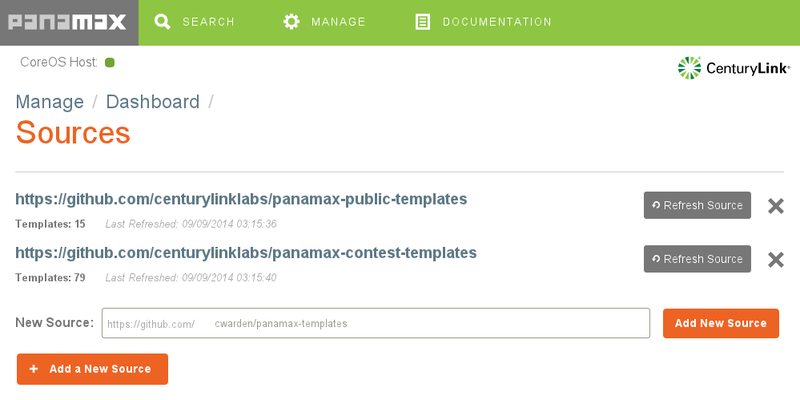
Searching for Panamax Templates and Docker Images
Now, on the search screen, if you search for "cube", you'll find my template.
(The first one is from the contest repo.)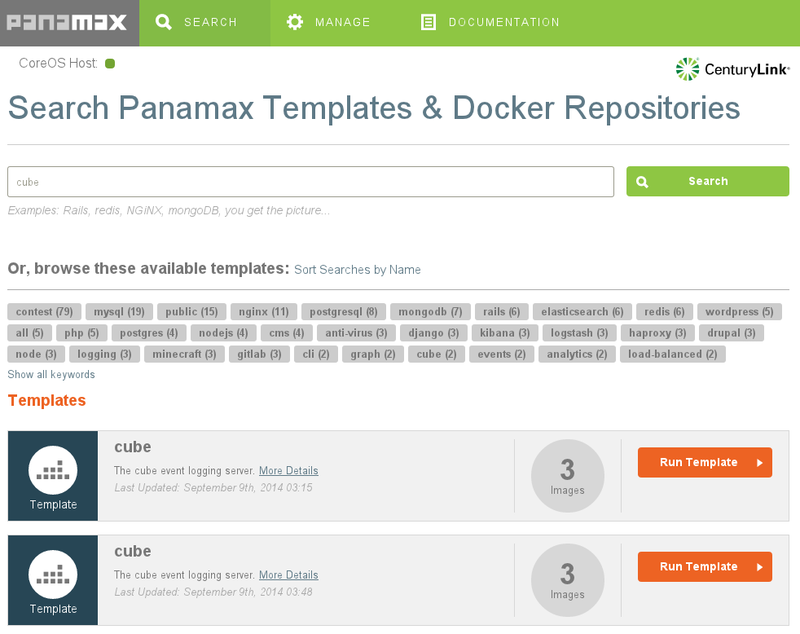
Below the templates, you'll also find individual docker images. If you wanted to build up your application starting from a single image, you could start with one of these.
Click on More Details, and you'll see that my template is made up of three docker images: a MongoDB database, the cube collector, which accepts events and stores them in the database, and the cube evaluator, which reads data out of MongoDB and computes aggregate metrics from the events.
The details modal window also shows documentation I wrote up when creating the template.
Creating an Application
Click on Run Template. This will create a new application called "cube".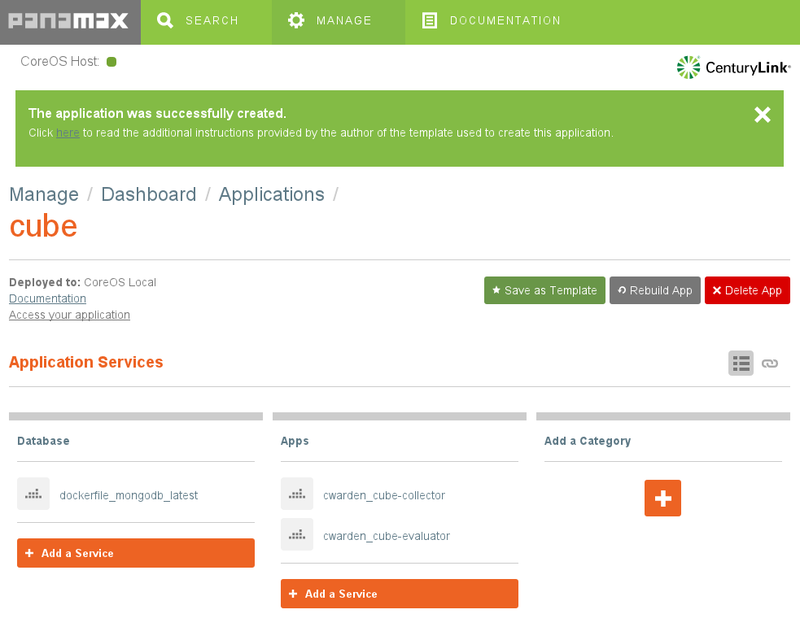
The Documentation link will show the same notes as on the More Details screen. The Port Forwarding section is important. Recall that Panamax and all of the docker containers it manages are running within a VM. If we want to access any of the services provided by these containers from outside the VM, we need to set up port forwarding.
In this case, we're going to add another docker container which sends data to the cube collector, but we'll want to access the cube evaluator from our host machine to make sure the logging is working correctly, so we need to set up port forwarding to VM for the evaluator:
$ VBoxManage controlvm panamax-vm natpf1 evaluator,tcp,,1081,,1081
(Instructions for sending data to the collector from the host machine are also included in the documentation.)
Prepare An App To Use With The Template
We'll use Valera Tretyak's simple hello world app for our application, making a small change to log each request to the cube collector.
Then we can create a docker image for this app and upload it to the Docker Hub.
$ docker build -t cwarden/hello-cube .
$ docker push cwarden/hello-cube
Extending The Template To Create a New Application
Now, let's actually use the template as a template by adding our new image as
another container. From Manage | Manage Applications | cube, let's add the
hello-cube service.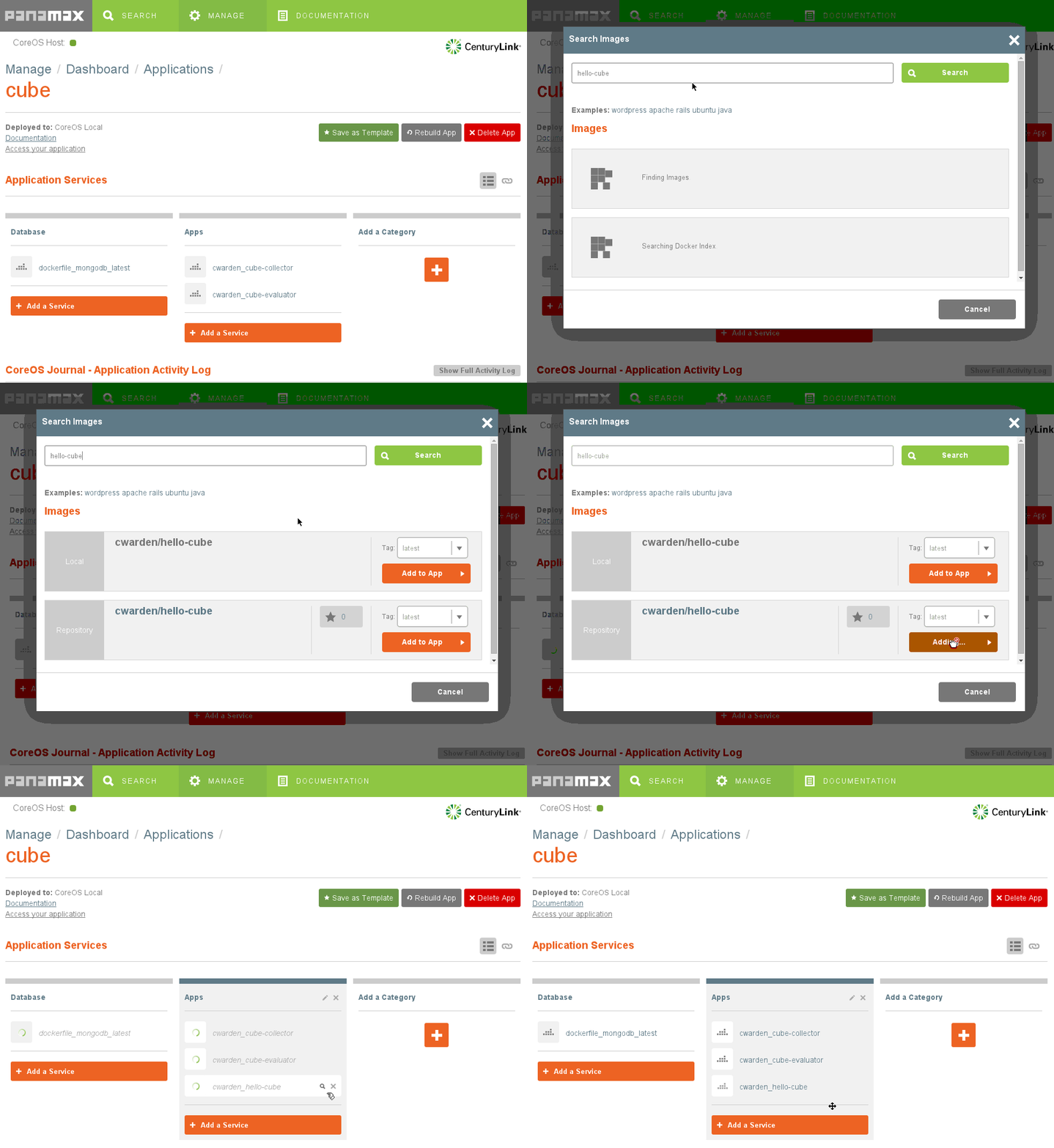
Next, we need to link the new container to the cube collector so it knows the
hostname and port to use when sending events. We also need to expose the
container's port to the VM. Click on the hourglass next to the hello-cube app.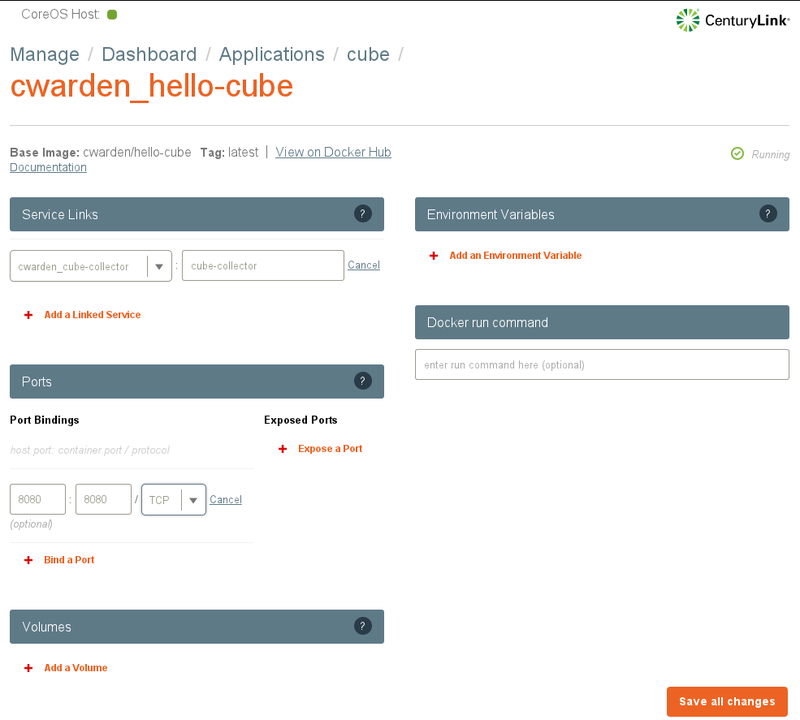
And we need to expose the VM's port to the host machine.
$ VBoxManage controlvm panamax-vm natpf1 hello,tcp,,8080,,8080
Using The New App
When we access the app on localhost:8080, it will send an event to the cube collector. We can use the cube evaluator to monitor the number of events being generated.
Exporting An App As A Template
Now that we've finished building our app, we can export the app as a new template to a github repo using the Save as Template button.
Thu, 05 Sep 2013
Estimating Tasks
As described in the previous post about our development process at GreatVines, we use LiquidPlanner for project management. Estimating how long tasks will take is important in most software development projects (and generally any project involving more than one person).
LiquidPlanner provides a great way of estimating tasks using an 80% confidence interval, but estimating tasks like this is a new concept for most developers. Below is a transcript with a developer that recently joined our project. We were able to get from "I have no idea how long it will take" to a decent estimate in about half an hour, but it should only take a minute or two for the next task.
2013-09-05 11:16:52: <Christian G. Warden> have you guys reviewed all of the
                     tasks for the september release?
2013-09-05 11:20:44: <Ben H> yes, but many of the tickets refer to parts of the
                     code I have no experience with so I have no idea how much
                     work they will be.
2013-09-05 11:23:11: <Christian G. Warden> you can put wide estimates on tasks
                     like that.  can you give me an example, and i'll walk you
                     through it?
2013-09-05 11:25:15: <Ben H> 10631525- Make Modal Form Fields scroll-able: I
                     have no idea where contacts are viewed in the application,
                     I haven't had any reason to look at their controller/model
2013-09-05 11:25:52: <Ben H> so any time estimate I would come up with would be
                     a sheer guess
2013-09-05 11:26:38: <Christian G. Warden> ok, no problem.  what's the
                     likelihood it will take you more than 2 weeks to complete
                     the task given what you currently know about the app?
2013-09-05 11:27:21: <Ben H> darn near 0% I would figure
2013-09-05 11:27:26: <Christian G. Warden> phew :)
2013-09-05 11:27:31: <Christian G. Warden> how about 1 week?
2013-09-05 11:28:29: <Ben H> that's still very high, so 2%?
2013-09-05 11:28:38: <Christian G. Warden> how about 3 days?
2013-09-05 11:28:40: <Ben H> given that it looks like pure GUI work
2013-09-05 11:30:03: <Jim Thompson> yeah Ben the problem is that one customer
                     has put so many fields in the FieldSet that you can't see
                     the entire modal, the Save and Cancel buttons scroll below
                     the page
2013-09-05 11:30:33: <Ben H> I guess 3-4 days (if it is pure GUI work then 1-2
                     should be more then enough, unless there's something
                     unseemly complex)
2013-09-05 11:30:45: <Jim Thompson> I am going to move this task beneath the
                     Performance items Christian
2013-09-05 11:30:47: <Jim Thompson> (and Ben)
2013-09-05 11:32:20: <Christian G. Warden> would you say there's a 10%
                     probability that it will take more than 4 days?
2013-09-05 11:33:34: <Jim Thompson> at 12-32 hours it might have to drop off
                     the list, or at least to the bottom
2013-09-05 11:34:40: <Christian G. Warden> jim, we'll go through the tasks and
                     reprioritize after the estimates are updated.
2013-09-05 11:34:57: <Jim Thompson> ok, I also moved "New Task" and "New Event"
                     to October, which is when we promised it
2013-09-05 11:35:39: <Christian G. Warden> you're interrupting my estimation
                     lesson    :)
2013-09-05 11:36:02: <Ben H> (yeah, he's been high balling for tutorial
                     purposes)
2013-09-05 11:36:11: <Jim Thompson> ok im out
2013-09-05 11:37:50: <Christian G. Warden> no, i want to come up with realistic
                     estimates.  if they're wide right now because of
                     uncertainty as to what it will take to complete them,
                     that's fine.  once we have estimates, we can decide
                     whether to invest time to come up with tighter estimates.
2013-09-05 11:38:44: <Christian G. Warden> so, do you think 4 days as a high
                     estimate is accurate?
2013-09-05 11:39:29: <Ben H> for this example I put 12-24, it's really wide and
                     most likely most of that will be learning about how that
                     GUI element is working and making the tests
2013-09-05 11:39:57: <Ben H> the range is more to show that it could go
                     horribly wrong if there is something there I have no idea
                     of
2013-09-05 11:40:24: <Ben H> but 12 still seems really high
2013-09-05 11:40:30: <Christian G. Warden> what's the likelihood that you will
                     complete the task in 2 hours?
2013-09-05 11:41:14: <Ben H> the likihood I'll complete it in 6 hours I would
                     meet the 10% threshold
2013-09-05 11:41:26: <Ben H> *likelihood
2013-09-05 11:41:38: <Christian G. Warden> ok, so, let's make it 6-24
2013-09-05 11:45:29: <Christian G. Warden> and you can check yourself by
                     imagining we're going to a casino.  you can choose from
                     two wagers:
                     1) roulette - there are 10 numbers on the roulette wheel.
                     if 1 or 10 comes up, you lose. if 2 through 8 comes up,
                     you win $100.
                     2) the bookmaker - if you complete the task in less than 6
                     hours, you lose. if you complete the task in more than 24
                     hours, you lose.  if you complete the task between 6 and
                     24 hours, you win $100. which wager do you want to take?
2013-09-05 11:47:25: <Ben H> bookmaker, it also means I can spend some
                     speculative time trying different approaches to find one
                     that solves the problem better
2013-09-05 11:47:34: <Ben H> if things go well
2013-09-05 11:49:16: <Christian G. Warden> so it's not really an 80% confidence
                     interval.  it might be more like a 90% confidence
                     interval.  you should make the range narrower.
2013-09-05 11:49:52: <Ben H> how then do you show the risk if (I doubt in this
                     case) that 10% could be really bad
2013-09-05 11:52:19: <Christian G. Warden> it's ok if there's an outlier
                     occasionally.  we want to get an accurate estimate across
                     all of the tasks.
2013-09-05 11:56:09: <Christian G. Warden> you should narrow the range until
                     you're ambivalent between taking the two wagers.  and
                     widen the range when you'd rather play roulette.
2013-09-05 11:58:02: <Christian G. Warden> but we've already gone from "i have
                     no idea how long it will take" to "i'm 90% confident, it
                     will take between 6 and 24 hours".
2013-09-05 11:59:40: <Ben H> I'm just worried it's misplaced confidence
2013-09-05 12:00:03: <Ben H> either way, given the range, I am (90%) confident
                     that I can get it done within the range
2013-09-05 12:07:07: <Christian G. Warden> nobody dies if you're wrong.  you're
                     expected to be wrong 20% of the time (once you narrow it
                     to an 80% confidence interval).  if we decide we need to
                     know with more certainty when something will be done, we
                     might ask you to spend an hour to do a little research so
                     you can come up with a tighter estimate, after which you
                     would adjust the high and/or low estimate.  for now,
                     though, estimate the tasks based on what you currently
                     know.
2013-09-05 12:07:50: <Ben H> ok
The roulette idea comes from Douglas Hubbard's How to Measure Anything.
Thu, 08 Aug 2013
GreatVines Development Methodology
In response to a customer's request for roadmap details, and not having the project artifacts they expected based on how they manage internal projects, I've written up a description of the development methodology at GreatVines.
Axioms of Software Development
The GreatVines development methodology follows from a few high-level axioms, draws from multiple software development and project management methodologies, and makes use of modern tools for collaboration.
The axioms:
- Requirements Change
- Priorities Change
- Delivering Useful, Working Software Frequently Is Our Primary Goal
- Delivering Updates to our Software is Cheap
The first two items, changing requirements and priorities, are related, and mean that we don't expect to be able to predict the future more than a few months out. We generally have a good sense of which new features customers want to make use of next month, but not those that will be most useful next year. Additionally, as we deliver new features to customers, requirements for enhancements to these features become apparent as we get feedback from them.
Item 3, delivering quality software, stands on its own. These first three items reflect what we think are the most important principles from the Agile Manifesto.
Item 4, that the delivery of updates is cheap, follows from the fact that we are a software-as-a-service company. The days of shrink-wrapped software are gone, and updates to both our web-based and mobile applications are delivered without end-user intervention. Because delivering updates is cheap and requirements change, we are able to deliver multiple iterations of new features, and adjust requirements as we discover exactly how customers are using our software and how they would like to use it.
Therefore, we aim to deliver useful, working software frequently under the assumptions that requirements and priorities change regularly, and that delivering updates to our software does not impose a large cost on either GreatVines or our customers.
Process
We generally organize releases into three- to four-week cycles, similar to Scrum sprints, but try to keep the next two to three releases planned as well so we're looking two to three months down the road. Like scrum and kanban, we start from a backlog of features that we would like to implement. We bring together team members from development, support, implementation, and sales when prioritizing the tasks for future releases.
Each release typically has a combination of small tasks, which may already describe a combination of technical requirements and planned implementation details, and larger tasks, the requirements for which need to be further elaborated.
In preparing the bigger tasks for an upcoming release, we work to ensure the requirements are clearly defined so development can proceed. Features that require a new user interface or significant changes to an existing interface are mocked up. There are often a few iterations of mockups, as questions are raised and addressed, and the requirements and mockups updated.
Depending on the feature, we occasionally share the mockups with existing or potential customers, and solicit their input before starting development, but we generally prefer to implement a working interface, then adapt it as we get feedback from real use.
As the requirements are fleshed out, we break them down into development tasks, referencing the mockups and relevant requirements. Each task is estimated by the developer that will be responsible for writing the code.
The tasks within a release are prioritized so if there is any slippage, the highest priority tasks get completed first. The assignment of prioritized tasks to developers ensures that each developer knows which task they should be working on at any time, and helps collaboration by letting all members of the team know who is working on what and how the priorities are defined. As in kanban, it also limits the amount of work-in-progress.
During development, we try to ensure the quality of the software through developer-written tests and peer review. For both our web-based applications running on the Force.com platform, written in Apex, and our mobile app, written in javascript, we make extensive use of unit tests. Although we don't follow a test-driven development process per se, we try to take a test-first approach with bugs; for new features, we typically write tests either in parallel with implementation code or subsequent to it.
We have found that testable code is better code. If it's hard to test, it's probably poorly designed, and needs to be decomposed.
During peer review, both the tests and implementation code are reviewed. We look for areas in which the design of the software can be improved as well as ensuring that the code follows our internal coding conventions to ease future maintenance.
With our mobile app, we have started writing automated functional tests as well as unit tests. The goal is to have the tests fully specify the functionality of the application.
When a new version has been released, our release notes are updated.
Tools
There are a couple important tools we use to support our development process. We use LiquidPlanner as our project management tool. Each release is organized as a package. We have our web-based application and mobile applications organized as separate projects, broken down into broad features using folders within the projects. We pull tasks from both projects into a release package.
Mockups for new interfaces that will be built as part of the release are done at wireframe level like one would do in Balsamiq Mockups. (Our mockups are actually often done as Google Drawings because Jim typically does them, and he has somehow become proficient at creating them quickly as Google Drawings.)
The use of ranged estimates in LiquidPlanner allow us to organize releases with a fair amount of confidence in being able to hit delivery dates. Estimating software development tasks is a continuing challenge, but we find the confidence interval-based approach superior to point estimates often used in project management tools and story-point estimates used in scrum. In the backlog, we often put wide estimates on broadly defined tasks, when it's not yet clear the value of the information provided by more granular requirements and estimates. When organizing a release, we break down big tasks into smaller ones, generally around one- to six-hours. Smaller tasks are easier to estimate more accurately, and estimates improve with practice.
LiquidPlanner also serves as a collaboration tool, minimizing project management overhead. As discussed above, the priority of tasks is unambiguous. We keep estimates of remaining work on tasks up to date, and LiquidPlanner automatically updates the schedule. Discussion about task details happens within LiquidPlanner so if there's a change to or clarification of requirements, there's one place to look. (When real-time discussion is required, we generally use Google Hangouts, then record the result of the conversation in LiquidPlanner.) Using LiquidPlanner mostly eliminates the need for "what's the status?" discussions.
We also track the status of code reviews and whether the code for each task has been merged within LiquidPlanner.
We use git and GitHub for version control. Our use of github follows how most open source projects are organized. We have a greatvines organization, which contains the primary repo, from which we package our software. Each developer has a fork of the repo. Developers create feature branches for individual LiquidPlanner tasks, and open a pull request against the greatvines repo when the code is ready to be reviewed. The pull request is noted in LiquidPlanner and the task is moved to a ready-to-review package, which puts the task on hold (not scheduled for further development).
Peer review is done within GitHub, using inline comments on the open pull request. If the task needs further work, the task is moved out of the ready-to-review folder in LiquidPlanner so it's scheduled for additional work. When the pull request is merged, the task is marked done.
Future Improvements
There are a couple areas in which we are planning improvements to our development process around testing. We are using jasmine and jasmine-jquery to do some functional testing of our mobile app, but it's not exhaustive, and we don't have anything similar in place for our Visualforce interfaces. Therefore, we augment our automated testing with manual testing. We would like to add more robust automated functional/acceptance testing, perhaps using a browser automation tool like selenium or casperjs.
As we further automate testing, we also plan on introducing continuous integration. Travis CI looks promising here, with tight integration with GitHub, and extensive use among open source projects already.
There are a couple areas in which we might experiment with changes in process in the future. One is in choosing which features should go into each release. We currently use a consensus building approach in which we informally consider the value of possible enhancements to our customers. I'd like to investigate whether there might be gains to be had from the use of more formal Decision Analysis practices.
We might also experiment with scrum-style user stories for documenting requirements. For the most part, our lack of a formal requirements documentation structure has not been a problem, and we are able to turn requirements into technical designs easily. But in cases where requirements are very broadly defined, the "As a user, I want" structure may prove valuable. Using a standard structure may also ease on-boarding of new employees and coordination with any contract or outsource developers with which we work.
Fri, 31 Aug 2012
Fixing "emulator window was out of view and was recentered"
Every time I tried to start an Android emulator, the window appear briefly,
then disappear, and I'd get the error, "emulator window was out of view and was
recentered". The solution is to edit emulator-user.ini in the
avd's directory, $HOME/.android/avd/<image name>, by
default, on linux. Set window.x and window.y to 0.
The solution is on stackoverflow, but Google couldn't find it.
Update 10/05/2012: I've found this solution to work inconsistently. A better solution under xmonad is to set up a ManageHook to match the emulator window and move it to the floating layer:
myManageHook  = composeAll
	[ className =? "emulator-arm" --> doFloat
	]