Sun, 13 Mar 2005
Getting a Toll-Free Number
We're getting business cards printed for Postica so we decided to get a toll-free number to put on them. It will be good to have on the web site too, since we currently just have our support email address.
A search on Google for 800 number or toll-free number brings up a ton of ads. We went with GotVMail because the price is good and we were able to sign up online in about 10 minutes. We didn't have to talk to a salesperson or fax any forms like other companies require. We're paying $9.95/month plus 7.4 cents/minute. If we start getting a lot of calls, we can start buying blocks of minutes for about 5 cents/minute.
Sun, 27 Feb 2005
ChangeThis Gets Lazy
ChangeThis, the publisher of cool little "manifestos", has gotten lazy with their latest batch. ChangeThis manifestos are digital pamphlets that focus on one specific topic. They usually short enough to read in one sitting, but packed with more information than you can fit on PowerPoint slides (not that I encourage the use of PowerPoint). The format is similar to slides, but they are designed to look good both on the screen and printed out. What makes them special is the thought that has gone into the design, making them difficult to avoid reading once you have opened one up. The content is generally a call to action or the author's insight into their particular area of expertise.
For example, they've taken a number of Joel Spolsky's essays (which are already compelling reading) and formatted them as manifestos.
This week, they've released two manifestos which, as they'd say on Sesame Street, are not like the others. The first, Shhh!, contains little cards that can be printed out and given to annoying strangers talking on cell phones. The design is clean, and the idea is cute, if somewhat tired. It doesn't follow ChangeThis philosophy, though. There's no individual behind it and it's not presenting much of an idea other than not to be rude on one's cell phone.
The second misfit is called Two Tomatoes, and actually
is some kind of manifesto telling consumers what kind of tomatoes to
buy, I guess. I'm not really sure what the content is because it's not
readable on my screen. Except for the cover page, it doesn't look like
anything else that ChangeThis has released.
Here's a typical page from a manifesto:
And here's the tomato one.
In Bubble Wrap Champ
 I'm an In Bubble Wrap champ! I love free books, and today I got my first free
book from In Bubble Wrap,
Creating Customer Evangelists

In Bubble Wrap is an advertising program run by 800ceoread in which you can win free business stuff, mostly books, every day. Thanks go to Seth for the head's up.
In other free book news, I have Paul to thank for a free copy of The Number.
I haven't finished reading it yet, but so far it's pretty good. The Number
Its discussion of retirement being a rather new concept is pretty interesting. One hundred years ago, most people worked until they died. Then, people started to live longer, get kicked out of their jobs, and die in poverty. Then came Social Security. Next up, long lives requiring savings somewhere north of -1.5% during the productive years.
Thu, 27 Jan 2005
Humans Replacing Computers
My auto insurance company, 21st Century Insurance, has had a nice web site for quite a while which would allow customers to update their policies online. Last year, for example, I removed my wife's comprehensive and collision insurance since her car isn't worth much compared to the premium.
Today, I got my renewal notification email. The 6-month premium for our two cars is about $900. I only drive my car about one day per week now, and since we live two blocks from my wife's school, she drives less frequently than that. Therefore, it wouldn't be a catastrophe if one of our cars were totalled and we only had one car. So I'm thinking of dropping comprehensive and collision on my car which is costing me about $700 per year.
The 21st Century website has a nice interface
where you can add and remove coverage, change deductibles, etc. and it will
show you how much your premium would change. After you save your changes, they
send you and updated policy and bill you or refund the difference.
Today, I clicked on the Change Coverage button and got the following javascript pop-up.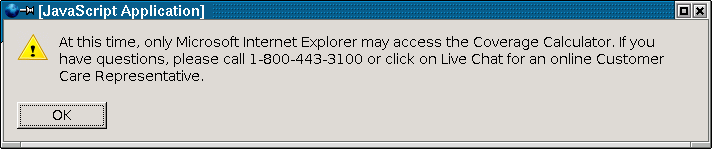
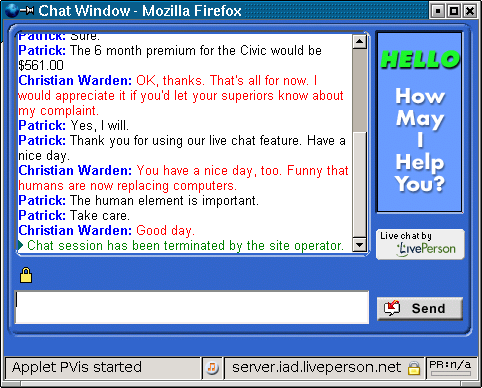
So I had to start up the Live Chat applet to ask Patrick about my policy change
and register my displeasure with the recent changes to his company's web site.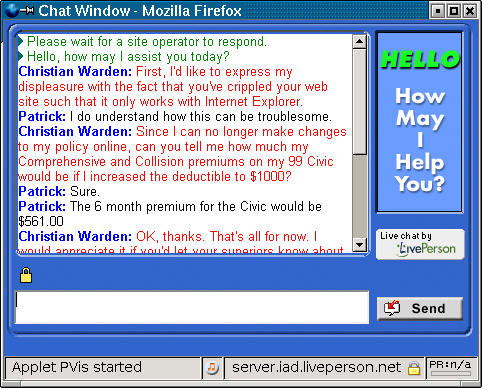
Sat, 15 Jan 2005
Learning Accounting
I've decided it's time for me to learn something about accounting. I've been
using GnuCash for a while to generate
invoices, but without understanding the underlying accounting. GnuCash has the
tendency to break either when it or one of it's many dependencies is upgraded,
crashing while spitting out errors like undefined symbol:
gnc_option_db_lookup_taxtable_option. It also has a long-standing bug
which causes invoices not be be printed
correctly when linked against GtkHTML 1.0 as it is in the Debian packages.
So I'm also looking for another accounting package to replace it.
Software
The first one I tried was Lazy8 Ledger, a java program. It's built as a plugin to jEdit making the interface kind of bizarre with text editing widgets where they don't seem to belong. In general, the interface just feels awkward, though with time, it might make more sense.
The next program I tried was FibuSQL. This program seems to be pretty immature and lacking much documentation. It claims to have been tested against MySQL and PostgreSQL, but the table creation script fails when using InnoDB tables.
Next up was SQL-Ledger. This looks very promising with lots of features and a clean interface. It has almost no (free) documentation though. The author sells the manual for $190. It looks like it generates nice-looking invoices and reports which is a plus. SQL-Ledger will certainly be a contender.
Next up is Quasar. It has lots of documentation and seems to be feature-rich. It's compiling now. (Tip for compiling on Debian: Install the libqt3-mt-dev package and set QTDIR=/usr when running configure.)
I also have a demo of Linux General Ledger, a proprietary ncurses-based application, to try out. It seems to be mature and well-documented. If it does what I need (I'm not sure exactly what that is yet), I'd be happy to use a mouseless program. Those Function keys are kind of far away for me, though. I'd prefer VI key-bindings. It's on sale for $29.95.
Accounting
Of course, to use any of these programs, I need to know something about accounting. The Lazy8 website directed to this great tutorial by Bean Counter Accounting. I finally understand debits and credits. I also picked up a book called Accounting the Easy Way which, 20 pages in, is good and reinforces what I've learned so far from the Bean Counter.
business » accounting | Permanent Link
Tue, 21 Dec 2004
Yahoo Money Manager No More
Yahoo is shutting down their Money Manager.
We regret to notify you that we are closing Yahoo! Money Manager, effective February 1, 2005, and your account will be automatically cancelled at this time. This closure means that we will no longer offer the following tools: Expense Manager, Net Worth, Finance Planner, and Account Access for banking, credit card, investment, and loan accounts.
It sounds like they're basically gutting Yahoo Finance if they're removing the ability to access investment accounts. I guess most banks offer similar services now, but Yahoo has always been good at keep a nice, simple interface.
I wonder if Google is working on something in this area.
Thu, 09 Dec 2004
Time Magazine Ads
There was one ad in a recent edition of Time Magazine that caught my eye. We've been trying to figure out how to best market Postica since officially going into production in July. I'm pretty skeptical about the effectiveness of advertising in general. Since we're bombarded with so much of it, I think most people simply ignore it. But every once in a while, some advertisement will catch my eye. I don't know if the fact that I read it means that it actually increases sales of the product advertised, but it obviously can't be worse than an ad that nobody reads.
The full-page ad in Time was for men's white dress shirts. Just plain, white button-down shirts that I buy every 5 years from Ross when the one I bought five years previously no longer fits. I had never heard of the brand; it was a man's name (two first names, I think). It was one particular shirt, rather than an ad for the brand in general.
What made me read the ad was simply that I wouldn't expect to see such an ad in Time Magazine. I wonder how sales of that shirt are doing. I believe one could order the shirt in question online or by calling an 800 number, similar to ads for overpriced cds composed of the Best Love Songs of Some Period within Some Genre or "collectible" coins that aren't legal tender.
Does placing an ad where potential customers wouldn't expect to see it help sales?
business » marketing » advertising | Permanent Link
Mon, 22 Nov 2004
Selling Apple
I sold half my Apple stock at $61.33 today. It's pretty damn expensive at this level.
Sat, 13 Nov 2004
Google Ads are Hard
We haven't had much luck with Google Ads for Postica so far. There's a lot of competition in the spam filtering market so it's hard to stand out among 10 ads for spam/virus filtering products and services on the same page.
It's frustrating having what I think is a great service, and not being able to reach potential customers. We're mostly focusing on selling through partners now, but we haven't completely given up on Google Ads yet. Here's our latest.
business » marketing » advertising | Permanent Link
Updated RSS Feeds
I've updated my screen-scraped rss feed  of Northern
Trust's Economic Research to include their International Comments.
Also, I don't think I mentioned it when I first set it up, but I also have a
feed of
the Prudent Bear news.