Mon, 21 Mar 2005
Bow and Arrow Taxes
All of the archers out there will be happy to hear that the Arrow Tax has been repealed. Alas, the Bow Tax still applies.
Bows
The 11% tax on bows will apply to bows having a peak draw weight of 30 pounds or more. This replaces the current law which applies to bows having a peak draw weight of 10 pounds or more. Broadheads suitable for use with certain arrows will be taxed as a part and accessory at the 11% bow tax rate. The effective date for both provisions is for articles sold after November 21, 2004.
Repeal of Arrow Tax
The tax on arrows that was in effect for arrows sold after November 21, 2004, and before December 23, 2004, has been repealed. The rules used prior to November 22, 2004, for arrow components still apply for the 4th quarter of 2004. Any tax that was imposed by the manufacturer, producer, or importer on arrows after November 21, 2004, and before December 23, 2004, may have to be refunded to the purchaser. See Changes Effective for the Second Quarter of 2005 for details on the tax on arrow shafts effective after March 31, 2005.
How much are we paying the members of Congress to make these laws? (Hint: It's less than $155,101)
Update: Unfortunately, those arrows aren't really tax free. Beginning March 31, there will be a tax on the arrow shaft.
business » taxes | Permanent Link
Quasar for Accounting
I decided to use Quasar to do my accounting. It's a huge improvement over GnuCash. Almost all of the fields have tab completion. For example, to create an invoice, I type the first few letters of a companies name, tab, and it fills in the company name and address. This works for accounts, tenders, and pretty much anything that is stored in another table.
I'm still learning how to use everything, but it's very well thought out. Initially, I didn't realize I could create a sale by entering the tender (Visa, American Express, etc.) on an invoice. I was creating an invoice, then a payment against the invoice, which took me a lot longer. I still need to figure out how to make invoices default to Account type rather than Item.
The account reconciliation feature works great. It helped me track down a transaction for which Authorize.Net didn't send me a receipt email.
Quasar has a ton of features related to running retail stores. I don't need to
deal with multiple stores and cash registers, but it's great that it's there if
I ever open up that pub.
Some of the cool features that I'll actually use include:
- Customer Groups. You can put customers into arbitrary groups and then run queries based on those groups.
- Cloning. You can create a copy of a journal entry, customer, invoice, etc.
- Recurring billing. I haven't played with this yet, but combined with the data import features, I'm hoping to automate the accounting of recurring online transactions.
Quasar has a good chance of becoming the de facto accounting package in the open source world.
business » accounting | Permanent Link
Sat, 19 Mar 2005
Bums Can't Work, Silly
Neville has a couple ideas for how to make a little money without spending much money.
1.) Sell Water. That's right. Buy a 24-pack of bottled water, ice it, then sell on a hot day. Your $3.00 investment has turned a $21 profit in a small amount of time. This may seem like something only a bum would do, but trust me, you will learn more from this experience than in any marketing class. Water can be substituted with soft drinks, hot coco etc.
This sounds like a good idea. Just go buy some water and sell it. You'll be in business in 15 minutes. On the way to the park, just stop off to get a Business License, Seller's Permit, and Sidewalk Vending Permit. Here's a list of the other licenses and permits you might need to be in the Bottled Water or Sidewalk and Street Vending industries. Of course, if you don't live in California, it might not be so easy to get your business started because, as Governor Schwarzenegger says, California wants your business.
Fri, 18 Mar 2005
Fed to Inflate Overseas
Tim, over at The Mess That Greenspan Made (my favorite economics blog by a non-economist), has compiled a good summary of the responses surrounding the Fed's notice that they're going to stop reporting M3.
If this comment is accurate, it's pretty interesting:
Perhaps you should wonder why even U.S. based contractors are being paid with suitcases of $100 bills, when they would prefer the payments be made by direct deposit to their U.S. account.
Buy gold.
The No-MBA Book Club
Seth Godin says that, in many cases, an MBA is a waste of time and money.
The fact is, though, that unless you want to be a consultant or an i-banker (where a top MBA is nothing but a screen for admission) it's hard for me to understand why this is a better use of time and money than actual experience combined with a dedicated reading of 30 or 40 books.
Not having been to business school, unlike Seth, it's hard for me to judge. I'm a big fan of book learning, but not school. I read two or three books per month. Recently, I've been reading more investment related books than business books. [Currently, I'm reading When Genius Failed and Conquer the Crash.]
Seth didn't list the 30 or 40 books to read, so Josh Kaufman picked up the thread. I'm surprised at how many books are on there that I haven't read. He has Guy Kawasaki's Art of the Start in there. The only Kawasaki book I've read is Rules For Revolutionaries which was hard to take seriously considering he added footnotes containing URLs for every company mentioned in the book. The one valuable lesson that I took away from the book was "Judge your results and other people's intentions" rather than vice versa.
There are a couple of books conspicuously absent from Josh's list.
- The E-Myth Revisited - If you're starting a business, you must read this book. It explains why you must make sure you are building a business and not just building yourself a job.
- The Design of Everyday Things
I'd probably also include Differentiate or Die and The Discipline of Market Leaders. I haven't found an "A Ha!" marketing book yet, but these two books both have good ideas. The premise of the former is that there must be something that differentiates your company from competitors. The author gives a few examples of ways to differentiate. The first is having your company's product or service associated with a specific attribute the way Volvo is (was?) associated with safety. The goal is to have your customers think of your company when they think of the attribute. Other attributes might be reliability, speed, spiciness, or indestructibility. Other ways to differentiate suggested is specialization and having a "secret ingredient". Interestingly, customers don't need to understand what the secret ingredient is or does. The author used the example of Sony's Trinitron. Customers want it, but what the hell is it?
The Discipline of Market Leaders breaks successful companies into three groups.
- Operationally Efficient - companies that develop very organized systems to run with the utmost efficiency, e.g. Walmart and McDonald's
- Product Innovators - companies that that constantly invent new things, e.g. Sony and 3M
- Customer Intimate - companies that go out of their way to do whatever it takes to make their customers happy, e.g. Ritz Carlton and Nordstrom's
Our goal at Postica is to be operationally efficient.
Update: There should really be an accounting book included. Accounting the Easy Way is fantastic. I wish I would have read it years ago. Before reading any books on investing (fundamental analysis), you should learn at least as much accounting as is covered in this book. I convinced a women at Border's who was wanting to learn bookkeeping to buy this book.
Mon, 14 Mar 2005
"I Refuse Your Business"
There's a story on CNN Money about some dude that makes t-shirts who refuses to sell them to Wal-Mart. There's no indication in the story that Wal-Mart wants to buy his t-shirts, which apparently feature naughty words and poker-related imagery. Good job in the publicity department, Mr. Carlton.
business » marketing | Permanent Link
Finished 1120S
I finally finished the federal corporate taxes for Postica, the 1120S and
related forms and schedules. It took a long time, but less than the 184 hours
that the IRS estimates. Seriously, the IRS estimates it will take more than
one man-month to file just the 1120S and K-1.
I filled out the return by hand first, and then copied the information into Taxsoftware.com's forms. Their software is
very minimalist, especially compared to TaxAct
which I've been using for years to do my taxes, first their Windows version,
now the online version. The Taxsoftware software is a bunch of Java applet
forms which, once completed, are used to generate a PDF form of the tax forms.
Unfortunately, I couldn't figure out how to fix the background color of
selected fields so I had to fill out each field blind, then remove focus to
verify that I had entered the correct value. I tried changing a bunch of X
resources to get the color to change, but was unsuccessful.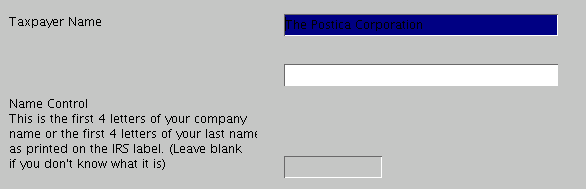
I'm almost done with the California return, 100S, too. Luckily, it's mostly copying data from the federal return. I do have to keep a separate depreciation schedule though since California doesn't allow the 50% bonus depreciation.
business » taxes | Permanent Link
Sleazy Used Car Sales Tactic
I received an advertisement in the mail from Superior Nissan of Mission Hills, located in Mission Hills, California. The return address on the envelope identified the sender as GM Notification Sender for some reason.
As part of their used car sales promotion, they claimed to be giving away some prizes. In the envelope was a card with two scratch-off numbers. If the numbers match, you're a winner of one of five prizes. The prizes are A) an XBox or PlayStation 2, B) a $500 gas card, C) a $1,000 shopping spree, D) a 60" Wide Screen Color TV, and E) $15,000. They might as well have made a trip to Mars one of the prizes too.
I scratched off my matching numbers, but of course, it doesn't say which of the fabulous prizes I've won. Instead, it tells me to call an 800 number to set up an appointment to pick up my prize at the dealership. If you're clever, you may have already figured out the scam. Here's what the small print says:
...the odds of winning prize A, B, D & E are 0:10,000, prize C is 10,000:10,000.
Everyone gets the "$1,000 shopping spree" on goshoppingmall.com which charges an outrageous amount of money in shipping and handling fees, generally between 40% and 60% of the price of the item. How slimy.
Renting Cheaper Than Buying
NPR
picked up The Economist's story about it now being cheaper to rent
than buy in many markets.
(Via patrick.net)
Sun, 13 Mar 2005
Smith Barney is Silly
After Apple's recent run up to almost $70 a share (over 10% since I sold half my shares 10 days ago), Smith Barney downgrades AAPL to hold, advises selling, and at the same time, increases their 12-month target to $75.
"Despite the fact that we are raising our target multiple on calendar 2006 operating earnings this morning from 26 times to 29 times, we cannot justify more than a $75 fair value in 12 months. And while this suggests another 10% upside from current levels, we can no longer recommend that medium- to long-term investors place new money into the shares," the brokerage wrote.
The downgrade occured today when the stock opened at 66.13. A 13% increase within 12 months seems like a good investment. So what should investors do, Smith Barney? Hold, sell, or buy this undervalued stock?