Sun, 08 May 2005
Walter Block on Walmart and Banking
Liberty Guys points us to a clip from CNBC in which Walter Block, Austrian economist, smacks down a congressman and a banking trade group representative who are whining about Walmart wanting to get into the banking industry. Good stuff.
My local Walmart has a Mexican bank in it for some reason, next to the McDonald's.
Sat, 30 Apr 2005
Clever 3M Ad

Apparently, only some of the money is real, but it's a brilliant idea
nonetheless.
business » marketing » advertising | Permanent Link
The Housing Bubble in Pictures
From Calculated Risk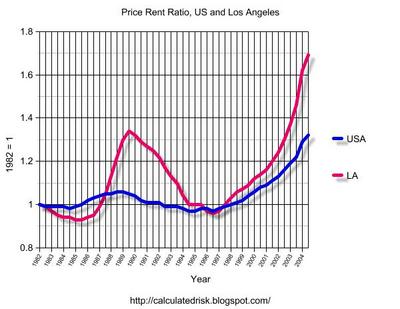
From Northern Trust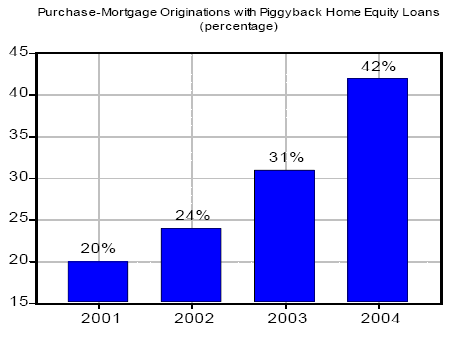
From The Miami Herald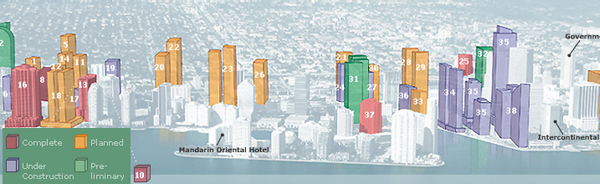
Sat, 16 Apr 2005
Irrational Real Estate Exuberance
Robert Shiller, the author of Irrational Exuberance, was on NPR's Talk of the Nation last week to discuss the housing bubble and to tout the second edition of his book. You can listen to it online.
One caller was a real estate agent who claims there's not enough land in Las Vegas and that it will become a land of high-rise living. Another said that Cleveland was becoming too expensive. As an aside, I spent a couple hours in Cleveland in 2000, and left with a favorable impression. Downtown seemed to be undergoing a lot of development.
From the book:
Irrational exuberance is the psychological basis of a speculative bubble. I define a speculative bubble as a situation in which news of price increases spurs investor enthusiasm, which spreads by psychological contagion from person to person, in the process amplifying stories that might justify the price increases and bringing in a larger and larger class of investors, who, despite doubts about the real value of an investment, are drawn to it partly through envy of others' successes and partly through a gambler's excitement.
iPod Shuffle On Its Way
My free iPod Shuffle from ex24 is on it's way. Like Jonathan, I bought one share of Costco. At its current valuation, the iPod cost me between $2 and $3.
Fri, 15 Apr 2005
Pricing That Doesn't Make Sense is Annoying
Seth Godin is trying to make a point about how people act differently when on camera.
Odd segue: Today, in anticipation of a dinner party, I stopped at a lobster seller in Chelsea Market in NYC. I asked for a six pound lobster. The pricing at the store is $9.95 a pound for small lobsters and $8.95 a pound for lobsters six pounds and up.
The lobster weighed (I'm not making this up), 5.97 pounds. For reference, that's just less than a pound by the weight of a penny. Feed the lobster a plankton and it would be six pounds.
He started to ring me up at $9.95 a pound. I pointed out the price breakdown and the guy shrugged and said, "It doesn't weight six pounds."
Two co-workers came over and with precisely the same uncomprehending grin, repeated his point. I added a penny to the scale but they weren't swayed.
So, the two questions are, "Do you think the owner wanted them to act this way?" and "Would they have acted differently if they were on camera?"
Maybe because it's obvious, but he doesn't mention the absurdity of the pricing scheme. The price for the lobster should, of course, be something like $9.95/lb for the first pound and $8.95/lb for each additional pound. Damn, it's annoying when you run into companies that have stupid pricing.
Mark Hurst describes a conversion with a Dell sales rep in which the sales rep explains that a computer without a monitor costs $400 more than the same computer with a monitor.
Taxes Kill Productivity
Cantillon's Paradise points to an AP story which says that Americans spend 6.6 billion hours on their taxes. It's rather ridiculous the lengths a citizen must go to in order to comply with the law. Luckily, our civil servants are working to resolve this issue.
Sensitive to the demands that tax laws put on weary taxpayers, the IRS has seven people working full time to reduce the anguish for filers. The IRS Office of Taxpayer Burden Reduction looks for requirements that can be streamlined, reduced or eliminated under the law.
Of course, there's only so much they can do considering the amount of tax law that are in charge of enforcing. Congress is responsible for the mess.
I've probably spent at least 60 hours on taxes so far this year, mostly reading IRS publications, including best sellers Business Expenses, Business Use of Your Home, and the much referenced tome, How to Depreciate Property.
My wife recently decided to change her major to accounting. I think I have the perfect internship for her.
business » taxes | Permanent Link
What To Do With The Big Moo?
The two books by Seth Godin that I've read, Purple Cow and The Big Red Fez, were both good. So, when Seth announced The Big Moo on his blog, I was excited about getting my hands on it. The Big Moo is a collaboration between Seth and 32 other business writers, with each writing contributing a chapter on how to make your business remarkable. As an interesting marketing idea, galleys (pre-release) versions of the book were offered in boxes of 50 for $2 each ($100 per box). Their goal was to get word of the book out early so big companies would buy truckloads of the book for their executives.
Back in 2000, the president of BNW bought everyone a copy of Tom Peters's The Professional Service Firm 50. The Big Moo is a similar type of book, but without the annoying typography (lots of different font sizes, bold, exclamation points, etc. I hate the style of writing in Peters's book. If you need to trick me into getting excited about your writing, you haven't written a very good book. Get me thinking, and I'll be excited.) It's not that it's a bad book, but it definitely under-delivers. Each of the authors contributed a single chapter, and most "chapters" are two or three pages long. It feels like you're reading a brain fart that the author couldn't bother to think through fully.
It's definitely not the type of book that forever changes your thinking: it wouldn't be included in a personal MBA list. So I'm not sure what I should do with 48 unread copies of the book (I did give one copy away). I can't give it to people saying, "You have to read this!" And I don't really want to give it someone and say, "Here's an OK book you might want to read if you don't have anything better to do."
If you want a copy, let me know. Some other readers enjoyed it more than I did. Meryl at Blogcritics.org gave it a decent review.
The book does what it sets out to do: motivate the reader to get out there to put ideas to work to develop a remarkable organization that gets everyone buzzing.
As does Jack at 800-CEO-READ. Though he seems to like the book mostly because the proceeds go to charity. That's not a very good reason to read a book. You'd be better off giving the money directly to charity and avoiding the printing costs.
Update (10/10/05): I managed to unload two copies. Thanks, Heather!
Update (10/18/05): John, who also took a copy off my hands wrote up a review on his blog.
business » marketing | Permanent Link
Sun, 03 Apr 2005
Housing Crash Links
I've created an rss feed of Patrick's Housing Crash
links. Many of the links don't make it to his blog.
Subscribe here
Scary Housing Numbers
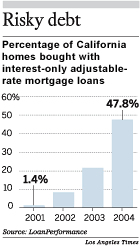 (Via Housing
Bubble) LA
Times has a story about the increasing popularity of interest-only
mortgages. An astonishing 47.8% of homes sold last year in California were
purchased with interest-only, adjustable rate mortgages. In 2001, it was 1.4%, and I'd bet that almost all of those were purchased by
investors who wouldn't be holding the property very long.
Many of these people are buying with no money down so when interest rates rise and they can no longer afford their mortgage payments, there's no disincentive to simply walk away from the property. You don't need to have very good credit to buy a house these days; what's a little bankruptcy blemish on one's credit report.
"I have $40,000 in student loans from my master's degree," Herron said. "I have high credit card debt. I'm a typical American. And yet they wanted to give me more debt to buy a house."
She wonders sometimes if she'll end up in foreclosure, if the bank will take her beloved home away from her when she can no longer pay her bills. Maybe it was a mistake to give her this money, maybe it was a mistake for her to take it. But she wasn't about to protest.
"If you're like me, you're so incredulous that anyone would give you any money whatsoever, you just close your eyes and sign the papers," Herron said. "I would have signed anything."