Sat, 02 Dec 2006
Government Shutdown
Schools and government offices shut down in Puerto Rico today after the government ran out of money. We could only dream of such a favorable resolution to a bankrupt government here on the mainland. Puerto Rico, being a commonwealth of the US, can't just pass a law to increase the budget deficit and then print up money.
Junk Mail Battle Continues
 Thursday, the mail carrier once again put the refused junkmail back in my
mailbox. I posted a copy of the relevent section of the postal regulations which
states,
1.1.3 Refusal After Delivery
After delivery, an addressee may mark a mailpiece "Refused" and return it within a reasonable time, if the piece or any attachment is not opened. Mail that may not be refused and returned unopened under this provision may be returned to the sender only if it is enclosed in a new envelope or wrapper with a correct address and new postage. The following may not be refused and returned postage-free after delivery:
a. Pieces sent as registered, insured, certified, collect on delivery (COD), and return receipt for merchandise mail.
b. Response mail to the addressee's sales promotion, solicitation, announcement, or other advertisement that was not refused when offered to the addressee.
Yesterday, he did it again and circled the following section:
1.1.6 Remailing Returned Mail
Generally, a returned mailpiece that was undeliverable-as-addressed or refused by the addressee may not be remailed unless it is placed in a new envelope or wrapper with a correct address and new postage. A returned shortpaid mailpiece can have the necessary additional postage affixed to the original piece and does not have to be placed in a new envelope or wrapper.
 The USPS carrier
exam apparently doesn't cover reading comprehension, as the above
regulation states that refused mail cannot be remailed once it has been
refused. Despite the fact that the refused mail is only traveling about 6
inches, since no additional postage has been paid, such a remailing would be a
violation. Today, I added a Post-it note to that effect.
Yesterday, I spoke with Lynda Buss, the local postmaster for Northridge. She was not much more helpful than the mailman. I pointed out that the Domestic Mail Manual stated that I could refuse the junkmail, and she said, "You can read the Domestic Mail Manual all you want," but that they were still going to deliver the junk mail. I said that was fine, but that mail that I refuse must not be redelivered. She made the absurd statement that if I refuse the junk mail, then the mail carrier won't know who lives there. The junk mail is not addressed to me personally, but "Postal Customer", "Resident", or similar. I emphasized that I would accept delivery of mail that was actually addressed to me. The only concession I could get out of her was that she would speak to the mail carrier to see what they could do. She's the boss. All she has to do is tell her subordinates to follow their own regulations.
Thu, 30 Nov 2006
Don't Throw Away Your Junk Mail
 Last month, I tried to alleviate
the flood of junk mail I receive my not removing it from my mailbox. The
idea was that the mailman would get the hint that I don't want it, and would
stop stuffing it in my mailbox. I suppose it could have been easily predicted
that such a tactic would be unsuccessful. If I were to eat at the same
restaurant on a regular basis, and I always left the pickle on the plate, the
server might notice that I don't want the pickle and stop bringing it to me.
The mail carrier's job, unlike the waiter's, isn't to please me.
Despite the fact that that my junk mail may be addressed to "Postal Customer", I am in fact not the customer while in the role of junk mail recipient. Rather, I am the victim of one organization taking money from another company to bring me garbage. Although I wasn't able to quickly solve my problem, my little experiment showed that I was not completely helpless in working to eliminate this annoyance.
About two weeks after I stopped removing the junk from my mailbox, the mailman asked why I wasn't taking the mail out. I told him that I was hoping he would stop delivering it. He said that it was hurting his wrist, having to shove in new mail. I told him that I didn't appreciate having to carry it up to my apartment to throw it away, and then have to carry it back out to the dumpster. He said, "I'm not going to argue with you," and refused to discuss it further.
So, keeping the junk mail in the mailbox at least provided the right disincentive to delivery of the mail. If I could just get another 20 million "customers" to also leave their junk mail in their mailbox, the mail carriers would either complain to their superiors, demanding higher wages, or face increasing medical costs due to sore wrists, which would have to eventually be passed to the real customers.
Unfortunately, I didn't have enough time to wait for the junk mail revolution to take hold, for my mailbox would soon be full and I wouldn't be able to receive my weekly copy of The Economist. There had to be another way.
Next to the mailboxes in our apartment complex, there's a note that says that the mailman would appreciate if we didn't put junk mail in the outgoing mailbox. Well, that certainly makes sense. If my job were to say have a dog crap on other people's lawns, I'd appreciate it if they not return it to my home. But you can't blame the poopee for refusing deliveries by the pooper.
I looked up the relevant regulations on refusing mail. Section 508.1.1.3 of the USPS Domestic Mail Manual states that basically any piece of mail can be refused by marking it "Refused".
So I took all of the junk out, wrote Refused on it, and stuck it in the outbox. The next day the mailman removed it from the outbox and left it on top of the mailboxes. It sat there for two or three days before he re-delivered it to my mailbox. I contacted the USPS through the form on their website to let them know that the mailman was re-delivering refused mail. I received a semi-personal email a few hours later telling me that a case had been opened, and that I would receive a phone call by the end of the next business day. They were only one day late, but I received a call on Tuesday. I explained what happened and was told that mailman would be spoken to.
I waited a couple days to give them time to talk to the mailman, and today re-refused the original mail as well as other junk mail that has since been delivered.
 Please join the fight to stop junk mail by refusing delivery of it. By
doing so, you provide a disincentive to its delivery, and put the burden of
disposal on the junk couriers.
If you are feeling especially ambitious and are willing the enter the den of evil, you can take copies of junk mail from each individual sender down to the local post office with form 1500 and get a prohibitory order against each. You will have to file a separate form for each piece of junk mail that you would like blocked, and although the form is meant to block sexually oriented mail, they may not refuse to accept your form because you seem particularly prudish. Check out the excellent Junk Busters page for more information.
Fri, 24 Nov 2006
A Rare Sight Captured on Film
On page 27 of the September 25, 2004 U.S. edition of Time magazine appears a picture of the President of the United States, George W. Bush, in which he does not appear to be an idiot.
Fascinating.
Creative Talent Tax Exemption
I had to pay business tax to the city of Los Angeles last month since I receive 1099 income. The city took $600 from me, but it turns out that "creative artists" who earn up to $300,000 are exempt from the business tax thanks to the lobbying of the Screen Writers Guild. I should move to New Hampshire.
business » taxes | Permanent Link
Zopa, Consumer Lending
The latest newsletter from Springwise, which lists new businesses from around the world, mentions Zopa, which they describe as "eBay for money". The concept is fairly simple.
Zopa is a place where creditworthy people who want to borrow money can get together with people who are happy to lend it to them. And because there's no middleman - the borrower just pays a 1% exchange fee to Zopa up front - both get a great deal.
They pool loans together so each lender's loans are distributed among 50 or so borrowers. Lenders can decide what type of debtors they want to lend to based on the debtors' credit.
Zopa is only open to UK residents. I wonder how such a system would work in the states with each state having different lending laws. It's an interesting idea, and easier than standing outside the check cashing store looking for customers.
business » ideas | Permanent Link
Sat, 04 Nov 2006
Amazon aStore
A few months ago, Amazon introduced aStore, which allows associates to create their own Amazon store. It's a cool idea, but unfortunately, the current version is pretty limited in fuctionality. The store creator can only pick nine featured products sold by Amazon to display in the store. Categories of goods to be sold through the store can also be selected, but with only limited control over which products show up within these categories through the use of keywords.
For the nine featured products, the store builder can write a little description, but it would be nice if the products displayed the seller's product ratings, comments, etc.
Anyway, here's my store.
Sat, 21 Oct 2006
How to Stop Junk Mail
I think I've figured out how to stop receiving junk snail mail. Unlike Kramer's method to stop the intrusions into his mailbox by the Pottery Barn catalog, which required that he fill his mailbox with bricks, this method keeps the legitimate mail coming. In fact, you probably will still receive Pottery Barn catalogs, but I'm mostly concerned with stopping all of the newsprint advertisements that get shoved in my mailbox. I don't want the ads from Ralphs, Albertsons, Vons, Jons, Food4Less or Vallarta Supermarkets.
The trick is to leave the junk mail in the mailbox. Only take the real mail out. Then, when the postal worker comes to deliver more mail, there's not enough room for more junk. I've only been doing this for about a week, but it seems to work. The junk mail is folded vertically, and the real mail is also placed within the protective shield of junk. I simply remove the envelopes in the center and leave the undesirable outer crust. I'm thinking about stapling all the junk together to make for easy removal and reinsertion, and to prevent the possibility of real mail sneaking in between.
Updates: This passive-aggressive attempt to stop junk mail was unsuccessful, but you can join the fight to stop junk mail by refusing delivery of it. The struggle continues.
Sat, 07 Oct 2006
How to Waste a Day
I've been quite busy with school and work lately, so I was due for a day of unproductiveness. Here's how I wasted a nice Saturday:
Switch from Bloglines to Google Reader - After switching from straw to Bloglines a few months ago, I've tentatively switched to Google Reader as of today. One particularly nice feature is that it only marks posts as read when you've actually viewed them, rather than when you view the feed. It's also easy to create a link blog because you can share posts with a keystroke.
 Fix Northern Trust Feed - I fixed my screen-scraped rss
feed of Northern
Trust research reports, which has been broken since around May I think,
when they updated their site.
Start Learning Lisp; Give up - I started reading Peter Seibel's book, Practical Common Lisp online, which
in turn, required that I start learning emacs. I got through about a chapter
and a half of the lisp book, and about half of the emacs tutorial before
deciding it wasn't worth the effort today.
Touch Base with the Housing Bubble - If you haven't heard, housing is
past the peak, and heading down.
I caught up on Mish's
blog, where the deflationary (rather than hyperinflationary) recession
looms large. And if you haven't met Casey
Serin yet, he's a 24 year-old facing forclosure five houses with $2 million
in mortgage debt. Bummer.
Sat, 09 Sep 2006
Restricting Mail Delivery Times with Exim
Denisa decided she doesn't want to feel compelled to check her email all day long, and asked me if there was a way to restrict the hours during which she could receive email. Since I use the magical MTA that is Exim, I was sure this must be possible. While I couldn't find explicit support for such a feature, I was able to hack something out. Here's my new local_delivery transport:
local_delivery:
  driver = appendfile
  envelope_to_add
  file = /var/spool/mail/${local_part}
  group = mail
  mode = 0660
  no_mode_fail_narrower
  return_path_add
  # hack to queue messages during certain hours
  message_size_limit = ${if ! and {\
    {match_local_part{$local_part}{+time_restricted_users}} \
    {or {{<{${substr_11_2:$tod_log}}{21}}{>={${substr_11_2:$tod_log}}{22}}}} \
  }{0}fail}
The trick I used was to force expansion failure of the message_size_limit when delivering a message to her address and when the current time matches our constraints, in this case before 9pm or after 10pm. The expansion failure causes the message to be queued. To ensure that she actually gets her queued messages during that one hour window, I added a new retry rule for our domain that retries every 15 minutes for four days, rather than the default rule which increases the interval between delivery attempts as the time on the queue increases. In case I ever want to configure other accounts similarly, I set up a localpartlist named time_restricted_users.
tech » mail | Permanent Link
Mon, 10 Jul 2006
Free Markets and Free Beer (IHS Summer Seminar)
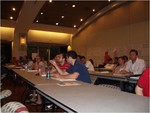 I spent last week at Georgia Tech in Atlanta attending a seminar put on by the
Institute for Humane Studies. Although the
title of the seminar was Ideas &
Entrepreneurs, the focus was more generally classical liberal/libertarian thought. The
lectures on public
choice theory and political science by Georg Vanberg and law by John Hasnas
were particularly interesting. If you have the opportunity to take courses
with either of them, I'm sure they would be fantastic.
For any students interested in free markets, individual rights, limited government, etc., I highly recommend attending an IHS seminar. They brought together a great group of young, thoughtful people. They also provide free beer at a social every evening.
I gave a short presentation on inflation during a student panels session
at the seminar. We were quite constrained on time so I had to rush through a
lot of information, but I think I did fairly well considering the
circumstances.
Mon, 26 Jun 2006
Blosxom Static Rending with Lighttpd
To get more familiar with lighttpd, I've switch over the web server on this machine from apache to lighty. The most difficult part has been replicating my apache setup to serve static blosxom files.
My goal is to serve a static html file if 1) a static version exists, 2) the query string is
empty, and 3) the request is not a POST. Because I've switched from using the
blosxom writeback plugin for comments to Haloscan, I don't have to worry about the third
condition, but it would be nice to figure out a way to replicate
RewriteCond %{REQUEST_METHOD} !^POST [NC] with lighty.
Here's what I've come up with in my lighttpd.conf:
$HTTP["host"] == "xn.pinkhamster.net" {
        server.document-root       = "/www/xn.pinkhamster.net"

        $HTTP["url"] =~ "^/blog" {
		cml.power-magnet = server.document-root + "/power-magnet.cml"
        }

	# There's no content at http://xn.pinkhamster.net/ so redirect to /blog/
        url.redirect = ("^/$" => "/blog/")

	# I'm not using the writeback plugin anymore so rewrite any
	# requests for writeback pages to the corresponding html page.
        url.rewrite-once = (
                "^/blog/(.+)\.writeback(\?.*|$)" => "/blog/$1.html$2",
        )

	# If there's not a static file served by the power-magnet, have blosxom
	# serve the page.
        alias.url = (
                "/blog" => "/usr/lib/cgi-bin/blosxom",
        )
        cgi.assign = ( "blosxom" => "" )

}
In order to serve the static pages, we have to use the power-magnet feature. The power-magnet is a CML (Cache Meta Language) script which runs for each request. In this case, we only run it for requests that start with "/blog". CML is designed to improve web serving performance by serving cached, static pages when possible.
CML scripts are written in Lua. My check for
an empty query string doesn't work yet; I'm hoping to get some help on the
lighty mailing list. Update: I've updated the check for an empty
query string so it actually works. There was a logical error in my first
attempt, but neither get.maxn ~= nil nor get.maxn ~=
0 works. So now I just loop through the query string values and update
a counter if there are any. It's not very efficient, but it works. The rest
of the script just checks for either a static index.html file if the request
was for a directory or the static version of the requested page, and returns it
if it exists. Update 2: I've updated the power magnet script to
not have to loop through the get array.
-- if query string is empty and static file exists, serve static file
dr = request["DOCUMENT_ROOT"]
-- local f=assert(io.open(dr.."/debug.out","a"))

-- this doesn't work how i think it should
-- if get.maxn ~= nil then return 1 end

i = 0
for k,v in pairs(get) do
        i = i+1
end
-- f:write("i = ",i,"\n")
if i ~= 0 then return 1 end

sn = request["SCRIPT_NAME"]

static = string.gsub(sn, '^/blog/(.*)$', '/static/%1')

if (file_isdir(dr .. static) and file_isreg(dr .. static .. "/index.html")) then
--      f:write("cache hit on directory\n")
        output_include = { dr .. static .. "/index.html" }
        return 0
elseif file_isreg(dr .. static) then
--      f:write("cache hit on file\n")
        output_include = { dr .. static }
        return 0
end

-- f:write("no cache hit\n")
return 1
Tue, 20 Jun 2006
Debian Virtual Private Server
I got a new virtual private server (vps) from a company called TekTonic today. I've been meaning to replace the Pentium MMX 200 that hosted this blog and my email for a long time. The virtual server is running within Virtuozzo, a commercial virtualization product, though the underlying technology is also available as the open source OpenVZ.
For $8 per month, I've got a virtual server running on a Dual AMD Opteron 246 with 128MB of RAM, 5GB of disk space, and 512kbps out (with unmetered inbound traffic). Since I had been running on an old piece of crap, I've already got everything set up to run fine within a small amount of memory. Apache is server mostly static pages from blosxom; Postman is my lightweight webmail application for the rare occassion when I need it; visitors for web stats; uw-imapd and exim (though I am using the heavy build with exiscan-acl) for mail; and the good old jabberd in case I ever find someone who uses jabber/xmpp. If I were running a database or some java application server, I'd need more ram.
The bandwidth is capped by the virtualization software which means you can't spike, but it also means no overage charges. TekTonic charges $50/month for an additional megabit which is pretty good.
They offer CentOS 4, Fedora Core 4, Suse 10.0, and Debian 3.1, and they had my Debian server provisioned in about 10 minutes.
I've only been running on the new server for about 7 hours, but so far, I'm very impressed. If you're reading this, the server is still up, so that's good.
Sat, 17 Jun 2006
Left-Handed Pens
A couple months ago on Digg, there was a post about putting a Mont Blanc refill in a Pilot G2 case. Some of the comments indicated that the G2 itself was a very good pen. So the last time I went to Wal-Mart, I tried out the G2, which is a gel ink pen. Unfortunately, it was not designed for left-handed writers. The ink takes way too long to dry, and if you attempted to write with it, you would end up with a page full of smudged ink. If you're one of those lefties who gives us a bad name by turning the paper perpendicular or even upside-down, perhaps you could make it work, but I'm not familiar enough with the acrobatics of that method of writing.
I must recommend that the left-handed stick with Pilot's Extra Fine (0.5) VBall Grip, the ink of which dries quickly enough to cause only the occasional gentle smudge.
On a related note, Mead sells left-handed notebooks which are just regular notebooks with the front and back covers swapped so it opens on left and you write on the page on the left with the spiral on the right. Although I'm a bit ashamed that it took seeing one of these notebooks to come up with the solution to spiral hand, I now open all of my notebooks from the "back" and write on the left page.
Blogs Need Pictures(?)
Russell says that blogs need pictures of their authors. I don't feel strongly one way or the other about it. I pretty much only read blogs in straw, so I don't see authors' mugs very often. For those that care, though, I've added my picture. The right side was pretty barren anyway.
Save the Date
My friend, Mike, is getting married later this year. I receive a "save the date" notice last week, followed by a second notice with a correction to the wedding's website.
I really don't understand the point of these notices. In order to send a save-the-date notificiation, you must already know when the wedding is, and if you know when the wedding is going to be, you almost certainly know where it's going to be held, especially if you're the type inclined to send out such notices. Furthermore, you know who you're going to be inviting because you wouldn't send a save-the-date notice to somebody who you aren't inviting. So, if you know all the critical details, why not just send out the invitations?
My hypothesis is that some couple actually had a legitimite need to send out such notices, such as an impending wedding date without a confirmed location. But some bachelorette received received one of these notices and decided her wedding had to have at least everything that her disorganized friend's did. And at some point, the stationer or wedding planner added save-the-dates to the checklist, and we'll be forever subject to such silliness until there is a cure to bridal irrationality syndrome.
Tue, 23 May 2006
Drunk Drivers Suck
We were rear-ended in a hit-and-run last night. The driver was apparently drunk. He hit us while we were driving about 35 mph on Washington Blvd in Culver City. We pulled over to the side of the road, and he floored it and took off. I then sped up to get his license plate number. We didn't have to pursue him for very long: he slammed into a parked car a few hundred meters from where he hit us, and we pulled over about 30 feet behind him.
I called the police, and while on hold, the driver got out of his car, and started walking towards us. Not wanting to confront a potentially violent drunk, I pulled in front of him. He got back in in his truck and sped off again.
The police arrived about 10 minutes later to take a report. Since there wasn't any damage to our car other than a little scratched paint and no injuries, the police officer asked if we really wanted to file a report. I wanted to make sure that we filed an official report in case we were needed as witnesses in the event of a subsequent vehicular manslaughter or something. If this guy didn't kill anybody last night, he got very lucky. Leaving the scene of an accident is also a crime, but unfortunately, he probably won't be prosecuted.
Overall, we were lucky not to have been hurt. I just hope the police can get this idiot off the road.
Sons & Daughters
Here's the video Fred Goss created to sell NBC/Universal on the idea of an improvised sitcom, which eventually turned into Sons & Daughters, the funniest show since Seinfeld, which was recently canceled after airing 10 episodes.
Fred has a blog on MySpace. He's considering doing an internet-distributed show, but it probably won't be Sons & Daughters because it'll probably be hard to scale down from the current 80-person crew/$700k-$1M per episode budget. Whatever he ends up doing, I'm sure it'll be hilarious.
Fri, 19 May 2006
EU to Print Its Way Out of Inflation?
The EUobserver reports that members of the European Parliament are proposing to print €1 and €2 notes to replace one and two euro coins. They argue that the public doesn't correctly value the coins, and thus, a switch to notes will curb inflation as consumers stop throwing the coins around frivolously. Yeah, that's the cause of inflation. It can't have anything to do with those responsible for actually printing (or minting) the euros or the banks that create money out of thin air.
If the EU wants to get rid of their coins, I'll be happy to exchange each €1 coin for a $1 Federal Reserve Note. Limited Time Offer. While Supplies Last.
Perhaps the US should eliminate the $1 note and make the $2 note the smallest. The latter tends to be overvalued by American consumers.
Naked Shorts
I was forwarded this email:
Date: Wed, 17 May 2006 22:43:49 EDT
From: xxxxxxxxx@aol.com
To: undisclosed-recipients: ;
Subject: If you invest in stocks, listen to this...from Bobby K.

Turn up your volume and set aside about 10 minutes to listen to this. Theres
a crack in the system whereby people can create bullshit shares of stock and
sell it, where in essense creating more shares than there should be and driving
a companies stock down and eventually destroying the company. Ive known about
this for awhile and so have politicians, however, if they tried to fix it,
the entire financial system of the U.S. would collapse.

Ive always said that the stock market crash we saw in 2000 that wiped out
alot of people would be a walk in the park compared to the next one that will
happen. I think within the next 1-3 years the topic of these bullshit "phantom"
shares will be the big one that will be the biggest hit the stock market has
ever seen. Dont paic, just be careful. The stock market is done. The crooks have
made billions in the last 60 years in the stock market and i think the shit
will hit the fan soon. Listen...


http://www.ultimateuploads.com/audio/view.php?play=10aa902b7bb9763edd29058fb220e350
I wrote the following response before listening to the audio. I should have guessed that it was the Overstock dude.
The CEO of Overstock.com bitches about naked shorts a lot.  Read
http://jeffmatthewsisnotmakingthisup.blogspot.com/.  Mark Cuban talks
about it on his blog sometimes too.  There was also a 60 minutes story
about it, but it wasn't very good as Leslie Stahl is about as
financially literate as a chihuahua.

While it's fraudulent to sell something that doesn't exist, the
purchaser of a share of stock is the one who would have a complaint if
he were unable to take delivery of said share.

The CEOs who bitch about it are the ones whose compensation is in the
form of stock options.  If they were speaking on behalf of the company,
they should be delighted that people are driving down the stock price.
The company can buy back its shares cheaply enriching the existing
shareholders.

Imagine a company that sells 1,000,000 shares at $10/share during an
IPO.  If short sellers drive down the stock to $1/share, and the company
can buy back all of its shares, it makes $9,000,000 without giving up
any equity (neglecting underwriting fees and the upward movement of the
stock price as the company starts to buy back a lot of shares).

Likewise, if you're a shareholder, and you think the stock is
undervalued at $1, you can buy more stock and wait for the profits to
come rolling in.

If your company isn't making any money, and you expect to make money on
the stock, well, too bad.

xn
Mon, 15 May 2006
Summer Reading List
Greg Mankiw and Arnold Kling have posted suggestions of books for economics undergrads to read at the beach this summer. Since they include mostly books I haven't read, I'll need to update my wishlist.
I added a couple books I thought would be good for the beach in Kling's comments:
- Walter Block, Defending the Undefendable
- Frederic Bastiat, The Law
- Steven Landsburg, Fair Play
In addition to the required readings for Mises University, I'm going to try to get through a bunch of books I've bought recently:
- Ludwig von Mises, The Theory of Money and Credit
- Ludwig von Mises, Theory and History
- Murray Rothbard, A History of Money and Banking in the United States
- Murray Rothbard, America's Great Depression
- F.A. Hayek, The Road to Serfdom
- F.A. Hayek, Monetary Theory and the Trade Cycle
- Jesús Huerta de Soto, Money, Bank Credit, and Economic Cycles
And if I manage to get through all of that, I've got Thomas Sowell's The Quest for Cosmic Justice and one of my inBubbleWrap books, Bill Bryson's A Short History of Nearly Everything.
Mon, 01 May 2006
Google and A9
A few days ago, Amazon's A9 replaced their main web search results pane, previously filled with results from Google, with "Windows Live" results. So I changed back my default columns to Google and Wikipedia. Then again this morning, Google was gone and Windows Live was back. But now, the Google results are nowhere to be found.
Sat, 29 Apr 2006
Free Gas
The Perfect Substitute points us to this tip on how to get free gas. Not to be outdone by the senators who want to send voters a bribe in the form of a $100 check representing a gas tax rebate (uhm, why not just cut or eliminate the tax in the first place?), the counties of Orange and Los Angeles in Southern California will give you a free gallon of gas if you run out on the freeway. I guess they need somewhere to spend all the extra cash they've been pulling in from property taxes.
Fri, 14 Apr 2006
Amazon's Photo Yellow Pages
Amazon's new Yellow Pages service with photos is the coolest thing I've seen in quite a while. There are a couple kinks to work out. I saw a couple pictures of buses, and they need to make sure not to take pictures of the rising or setting sun, but overall this is a fantastic service. It will be even better when it covers residential areas and is integrated with driving directions.
If you're coming to visit me, I'm just up the street from this Chinese restaurant.
Update: Russ isn't as impressed. Apparently, they've had something similar in Madrid for years.
Concatenate PDFs
How to Concatenate PDFs
- Install pdftk. I suggest
apt-get install pdftk. - Create a shell script call pdfcat:
- Run
pdfcat file1.pdf file2.pdf file3.pdf > files1-3.pdf
#!/bin/sh

pdftk $* cat output -
Mon, 10 Apr 2006
On Illegal Immigration
Immigration, and illegal immigration in particular, is a hot topic in the US Congress and among the population in general. Mark Trahant, in an editorial in the Seattle Post-Intelligencer, argues that immigration to the United States is nothing new, and that the same issues which the country now faces have endured since the founding of the country. These concerns are: the failure of new immigrants to assimilate; the fact the new immigrants are entering the country illegally; and that Americans' jobs are at risk because of immigration.
Although there are parallels to the past, it is undeniable that immigration is now out of control in this country. Ninety percent of Americans consider illegal immigration to be a problem.
These immigrants are bringing their foreign culture with them. The immigrants that come from Mexico and Central America have two to three times the number of children as native Americans. These children must then be educated at taxpayer expense. The US cannot afford to feed and educate the world's destitute masses. We must stop illegal immigration now. If we keep the current immigration policies in place or further expand the decriminalization of illegal immigration by granting amnesty to those who have already entered the country illegally, the US economy will deteriorate until it reaches parity with Mexico's.
In addition to the economic war US taxpayers are fighting against the onslaught of illegal aliens, the United States is currently engaged in a war on terror. Mexico may claim to be an ally of the US, but the lack of Mexican troops in Iraq shows that Mexican values are clearly not aligned with America's. Can we really afford to let our enemies into our country?
Just as during the period following World War I, we must again stand vigilant against those that wish to enter our country illegally. Those that spit in the face of the laws of our sovereign nation must be treated like the criminals they are. If one enters this country by trespass, they are criminals by definition. With no respect for the law, they will surely have no qualms about dealing drugs to our children and mugging our elderly.
It has been argued that the immigrants come here to do the work that Americans will not do. In Los Angeles, move than 30% of students drop out of high school. Certainly, these uneducated natives will do the low-skilled work that it is claimed only foreigners will do. These Americans need to have jobs to support their families. How will they be able to survive with immigrants taking their jobs and driving down the wages in those few jobs Americans do find?
Globalization may be improving the standard of living for the world's poor, but we must not allow it to do so at the expense of good, honest Americans.
The above essay is an assignment for my philosophy class in which I am supposed
to use only bad arguments. I tried to avoid good arguments while, at the same
time, not letting my bad arguments become too absurd. Try to find the
following common fallacies of reasoning:
Mon, 03 Apr 2006
kdissert
While working on a paper on immigration for a Model UN-type project, I discovered a great program called kdissert. It's a mind-mapping tool designed to help write papers and presentations. A mind map is similar to an outline, but ideas are laid out radially.
I usually use vimoutliner to organize my thoughts for a paper, but one problem I have when using vimoutliner is getting the text into OpenOffice for final editing. I generally convert to docbook, then to xhtml which I import into OpenOffice. Unfortunately, line breaks within the original text are preserved so the text doesn't wrap properly in OpenOffice. I'm sure I could fix this by either preprocessing the text prior to conversion to docbook or processing the docbook text, but I though I'd try something new.
Kdissert can export directly to OpenOffice and LaTeX. I found a small bug in
the OpenOffice generator in which URLs to linked documents are not properly
encoded, but the author of kdissert, Thomas Nagy, quickly addressed it. A PNG
of the entire mind map can also be generated.
Unfortunately, I never finished my immigration paper; I couldn't
figure out a way to reconcile my position with that of the US government which
I was supposed to be representing in the simulation.
Fri, 24 Mar 2006
Senators and Households
Max Clark points out that American, both the ones who run the government and the ones that run the PTA, are prone to short-term thinking.
If you have paid any attention to the news lately you should be aware that the Republican controlled Senate is discussing changing Senate rules to eliminate the filibuster.
...
What are they planning to do when the Democrats are back in power? And here is where short sidedness takes over. The answer is nobody cares. Why? Because by the time it happens it won?t be their problem.
He points out that a similar short-sightedness is plaguing those buying homes with ARMs and interest-only loans at a time when long-term interest rates are at historical lows.
Maybe they think the end of the world is near, so what the hell.
Sun, 12 Mar 2006
Shorting Residential Real Estate
Patrick wants to short the housing market. This is something I've thought about over the past year or so.
I could short builders, mortgage banks, or Fannie Mae, but that's not exactly the same, and I'm not as confident they will fall.
I'm not sure why he doesn't want to take a short position in equities that are likely to track housing prices. If prices start to fall it'll likely be because people are defaulting on their mortgages. This will negatively impact those holding mortages, i.e. banks, Fannie Mae and Freddie Mac. As Greenspan pointed out, the GSEs are holding onto lots of mortgages.
I read How to Profit from the Coming Real Estate Bust yesterday, and the author, John Rubino, suggests a number of ways to make money when the euphoria ends. He, of course, suggests shorting the GSEs, banks, and builders. But the housing market doesn't exist in a bubble (pun intended). The fall in housing prices is likely to correspond to a fall in the dollar. It is foreign investment in dollar debt that is helping to keep interest rates low. When foreigners get tired of financing American consumers, and not making much money doing so, they'll take their money elsewhere causing the dollar to fall. (Yes, I realize it's not that simple. Foreign governments also want to keep their exports affordable.) To get them back, we have to offer higher returns, i.e. higher interest rates, on their investments. Higher interest rates make for grumpy homeowners with ARMs, over half of recent home buyers. For a thorough discussion of the problems ahead for the dollar, check out The Dollar Crisis: Causes, Consequences, Cures. Rubino thinks Swiss Francs are the way to go. I'm not sure of that. I have money in Yen and Canadian Dollars right now. Subscribe to Chuck Butler's Daily Pfennig for daily commentary on foreign currencies.
Gold and other precious metals are another way to make money from a falling dollar.
Some more directly housing related stocks to short are those of title insurers, appliance and furniture manufacturers, property development companies and REITs. He also suggests going long apartment REITs and health care REITs. Apartments should do well, but I'd be more wary of the latter. REITs that own nursing homes should do OK, but I'd be hesitant to invest in hospitals which seem to be closing with increasing frequency as doctors are required to provide services to people who don't pay their bills.
Keynes Was a Socialist
Brad Delong (via Calculated Risk) has posted part of Paul Krugman's introduction to Keynes's General Theory of Employment, Interest and Money. Having not ready General Theory yet, I'll have to comment on Krugman's interpretation of it.
Stripped down, the conclusions of The General Theory might be expressed as four bullet points:
- Economies can and often do suffer from an overall lack of demand, which leads to involuntary unemployment
- The economy's automatic tendency to correct shortfalls in demand, if it exists at all, operates slowly and painfully
- Government policies to increase demand, by contrast, can reduce unemployment quickly
- Sometimes increasing the money supply won't be enough to persuade the private sector to spend more, and government spending must step into the breach
Sorry if my comments are naive; I am but a budding student of economics.
1. How can an economy suffer from an overall lack of demand? The overall
demand in an economy is made of up of individuals' demand. Who is Keynes
to say that my demand is too high or low? The most I could demand today is
limited by my productivity since birth plus any wealth gifted to me. If I
decide for forgo consumation today for tomorrow, no one has the right to demand
that I trade with them today.
2. If there isn't enough demand for what I can supply, I must find something else
to supply. For example, if I decide that the demand for my services as a
computer consultant are not sufficient to generate the income I desire, I might
go back to school to study economics. (Yes, I know I'm probably deluding
myself to think that my services as an economist will be more valuable to
society, but at least it's fun.)
3. How can government increase demand and reduce unemployment quickly? Let's see.
They can print out some money. Of course, they have to do this sneakily. If
they were to announce, "Tommorrow, we are going to increase the money supply by
1%," everyone would increase their prices right away (except for those lenders
and employees with dollar-denominated contracts; they're screwed). Instead,
people must be caught by surprise that they now have come into more money,
thinking that it must be due to their prowess and innate brilliance, so they go
out and spend their new dollars of spinning hubcaps and macaws.
4. Or, rather than just injecting money into the economy, the government itself
can go shopping. Of course, since the government doesn't actually produce
anything, it can only spend the wealth that it confiscates from its citizens.
Now, they might not take that money from you today, but they'll get you for it
later. And to make matters worse, when the government goes out to Walmart to
spend some money, they're competing with you, and thus forcing prices up.
Thu, 09 Mar 2006
Cheating with Turnitin.com
Turnitin.com is a service schools can use to detect plagiarism. Students submit their papers to turnitin.com, in MS Word format, I guess, and it analyses the text for plagiarism. Here's how the company describes it:
The industry's most advanced search technology that checks papers against our in-house copies of both current and archived internet content and our proprietary database of millions of previously submitted student papers.
My Economics professor told us an amusing story this morning about turnitin.com. She is on a committee that was evaluating using the service. Going through a demo of the service while on the phone with a rep from the company, she asked what happens if the student hides nonsensical characters within the text by replacing whitespace with characters in a white font. She went ahead and tried it with the sample plagiarized poem the company provided. Lo and behold, the poem was reported as not being plagiarized. Despite one professor's continued desire to use this $5,000 service, the committee opted not to.
Sun, 19 Feb 2006
iPod Shuffle Still Won't Shuffle
I thought that perhaps the reason why my iPod Shuffle wouldn't shuffle was that I had created the directory structure and loaded the files using gtkpod rather than iTunes. To test this theory, I wiped everything from the iPod's filesystem, started up VMware with Windows XP, installed iTunes, and loaded about three albums of music onto my iTunes-initialized iPod. I disconnected the Shuffle, switched to shuffle mode, and pressed play. Nothing. Back in linear mode, it works fine.
As a new consumer of Apple products, I'm not terribly impressed. The end cap on my shuffle doesn't quite fit correctly. When it's on, I can feel the raised edge where the cap meets the Shuffle. It's not a big deal, but it doesn't live up to the expectation that Apple products are engineered to perfection. It definitely falls short of the excellence achieved by the Tivo Remote, for example.
I'll probably stop into an Apple store to see if they'll replace my defective Shuffle. I'm not expecting much, though. My friend, Randy, is on his second defective iPod. His current one is having a battery problem and (from what I overheard in the cubicle farm), even though it is still under warranty, Apple wants him to pay $30 to ship it to them.
Postman/C-client Certificate Problem
When I upgraded my mail server from Woody to Sarge, Postman, my webmail client, stopped working. When trying to log in, I got the following error:
Error: Certificate failure for mail.xerus.org: self signed certificate: /C=US/ST=California/L=Los Angeles/O=Xerus/CN=mail.xerus.org
It turns out that the newer version of C-client, the library that postman uses for IMAP, automatically tries to verify the certificate, even if you have postman configured to connect to the non-SSL port; I guess it calls STARTTLS. Since I'm only using a self-signed certificate, I get the error above.
The solution is to configure postman to not verify the certificate using the
novalidate-cert switch in /etc/postman/interdaemon.cfg.
[mail.xerus.org]
imapserver     = mail.xerus.org/novalidate-cert
imapport       = 143
smtpserver     = localhost
;for SMTP authentication. 0=No,1=Must,2=Try
authsmtp       = 0
maildomain     = xerus.org
mailboxprefix  =
remotepath     = ~/mail/
deniedservices =
tech » mail | Permanent Link
The "Problem" of Evil
During my first Critical Thinking class, the the professor assigned a paper on the problem of evil. Here's how Wikipedia describes the problem of evil:
The problem of evil assumes that God is both benevolent and omnipotent. One formulation of the problem of evil may be schematized as follows:
- If God exists, then there would be no evil in the world.
- There is evil in the world.
- Therefore, God does not exist.
Our assignment was to come up with an argument against the problem of evil. It was definitely a good way to dive into the course. I spent a lot of time thinking about the problem and reading up on arguments that others had come up with.
I think I did a decent job considering the minimal amount of instruction we received prior to the assignment and my rusty essay-writing skills.
Christian G. Warden
Word Count:
1058 In Evil and Omnipotence, J. L. Mackie summarizes the problem of evil to show that the theist's belief in the existence of God is irrational. Not only is reason unable to prove the existence of God, but the beliefs of the theist are in direct conflict with each other.
The problem of evil argues that, because of the nature of God and the existence of evil, God cannot exist. The main beliefs regarding God with respect to the problem of evil are that God is omnipotent and omni-benevolent. Though not explicitly stated by Mackie, it is generally accepted that God's omnipotence subsumes his omniscience; that is, there are no situations over which God could not have control due to his ignorance thereof. The conflict arises because, in spite of God's all-powerful and all-good nature, evil exists.
If God were omnipotent and omni-benevolent, he would prevent evil from occurring. Therefore, accepting the premise that evil does exist, either God does not exist, or God is either not as good or not as powerful as is commonly held.
Mackie points out that the problem of evil is only a problem for people who believe that God exists, and that God is omnipotent and omni-benevolent. No such problem exists in the minds of brights (those with a naturalistic view of the world), polytheists who believe in gods with conflicting goals, nor monotheists who believe in a god which has limits to its power, knowledge, or goodness. For example, consider the following argument regarding a different supernatural being, the Flying Spaghetti Monster1:
If the Flying Spaghetti Monster (FSM) exists, everyone would be a pirate.
Everyone is not a pirate.
The FSM does not exist.
Few objections would be raised to the conclusion above because, to paraphrase Richard Dawkins2, we are all Flying Spaghetti Monster atheists; there is no "problem of pirates" commonly discussed among philosophers.
So, in attempting to rebut Mackie's argument, we must presume that God exists or, at least, that we have strong reason to believe that God exists.
We can concede that the premises of the problem of evil conflict without accepting that the conclusion is valid. If we accept that the God is great (omnipotent and omni-benevolent), it follows that God would not, and indeed could not, have created a world with evil. Furthermore, if the world God created were about to be subjected to evil, he would be able to and would be compelled to prevent it. That would mean that the second premise, that evil exists, must be false. The existence of evil seems self-evident, though. So how can we claim that evil does not exist?
We can think of evil as being relative to good. Every act by a human could conceivably be better (more good) or worse (more evil). Likewise, any natural act that affects mankind could be better for mankind or worse. There is no concrete distinction between an evil act and a good one. There can only be judgments made between the relative goodness of two acts or events.
When we say that God is all-good, that means infinitely good. If there is an infinite scale of goodness in our world and all possible worlds, there is always the possibility of more goodness, for infinite means that there are no bounds. So, the problem of evil could be similarly stated as the problem of imperfection:
If God exists, the world would be perfectly good.
The world is not perfectly good.
God does not exist.
Stated this way, it seems more logical to accept that God is omni-benevolent despite the fact that we can find evidence in the world of imperfection.
If we consider good and evil not as a duality, but rather a scale of goodness, it becomes clear that the case for saying that evil exists is not quite as strong. Instead, it might be better stated that the best scenario does not always occur. But this is a necessary condition of a world in which goodness is infinite. For any event perpetrated or allowed to occur by God could always be upstaged by an even better one.
It is also possible that humans, not being omniscient, are unable to appreciate an apparently evil act in its full context. Because there are an unlimited number of events occurring in the world, and an unlimited number of interactions among natural events and living beings, both sentient and not, it is impossible to judge the totality of a single event's goodness. Often, different value judgments will be made upon an act viewed from different perspectives.
Consider the execution of a convicted murderer. The family of the murderer's victim might view the execution as the ultimate good act, while the murderer's family might view it as the most evil. Taking into account the values of the rest of society or humanity, the execution would be valued as somewhere in between the two extremes. The value of the act would be different still in the context of subsequent events that it influences.
While it seems all too easy to find evil in the world, upon further contemplation, such evil can easily be redefined in terms of its relative position on a scale of goodness. And although an argument against the problem of evil does not prove the existence of God, it demonstrates a method of reconciling a belief in God with the apparent evil that surrounds us.
Murray, Michael, "Leibniz on the Problem of Evil", The Stanford Encyclopedia of Philosophy (Spring 2005 Edition), Edward N. Zalta (ed.), <http://plato.stanford.edu/archives/spr2005/entries/leibniz-evil/>.
Wikipedia Contributors, "Problem of evil", Wikipedia: The Free Encyclopedia, 7 February 2006, <http://en.wikipedia.org/w/index.php?title=Problem_of_evil&oldid=38547800>.
Wikipedia Contributors, "Theodicy", Wikipedia: The Free Encyclopedia, 4 February 2006, <http://en.wikipedia.org/w/index.php?title=Theodicy&oldid=38081634>.
1 The Flying Spaghetti Monster is fictional god-like being invented in 2005 CE to parody the "Intelligent Design" advocates wishing to teach creationism in US schools. One of the defining characteristics of the FSM is its fondness for pirates. See www.venganza.org for more information.
2 Richard Dawkins states in "The Root of All Evil?", a television special for Channel 4 in the UK, that we are all teapot atheists with respect to Bertrand Russell's teapot in space.
My argument is admittedly weak. Our second assignment is going to be to rewrite this essay, so hopefully the class will have improved my arguing skills before then.
Update: I've completed my second paper on the problem of evil. I had the option of changing my argument to be in agreement with the problem of evil, but I got lazy, and kept my original argument.
Sat, 18 Feb 2006
Back to School
I started back at school last week. After dropping out of the computer science program at LMU almost 9 years ago, I'm going to give school another shot.
I'm going to Pierce College, a local community college. I hope to transfer to UCLA or one of the other UC campuses next year to study economics.
Mon, 16 Jan 2006
Schwarzenegger Causes Traffic
 I got stuck in traffic on Friday because Schwarzenegger was standing on a pile
of rocks next to the 405 in front of a bunch of TV cameras. He was causing
traffic while announcing funding
for a carpool lane.
Thu, 05 Jan 2006
Good Coffee


So, I finally got a proper coffee machine, a DeLonghi espresso maker. I bought some pre-ground espresso from Caffe Latte on Wilshire since I only have a whirling blade grinder, which I've read is not recommended for espresso. I'll try out the grinder later, but I wanted to make sure that my first cup of coffee was delicious, and it was. The machine also came with some Illy pods, but I haven't tried them out yet.
Now that lattes don't cost $3, I want to drink them all day, and I'm worried about excessive caffeine intake. The problems of living in modern society...
Abuse of Popular Credulity


I don't know how courts work in Italy, but in the US, witnesses are asked to
swear on the Bible. Doesn't doing so assume that the text within is factual?
I don't think they let you bring in your own books
Mon, 02 Jan 2006
Losing Money Vicariously Through Slate
 I have the fantasy of opening up a little cafe, apparently like many other
people. Michael Idov has already done it and documented the money-losing venture
at Slate.
His cafe, which he opened in Manhattan, was right out of my fantasy, "where coffee was served on silver trays with a glass of water and a little chocolate cookie" — it's actually a little chocolate square in my imagination.
He goes on to describe how he lost money on every croissant sold, and how he and his wife end up working "$8-per-hour jobs slinging coffee" before going bankrupt.
The European cafes that Michael tried to emulate probably don't $4,500/month rents to pay, because I don't think they get the to-go business that makes Starbucks so profitable.